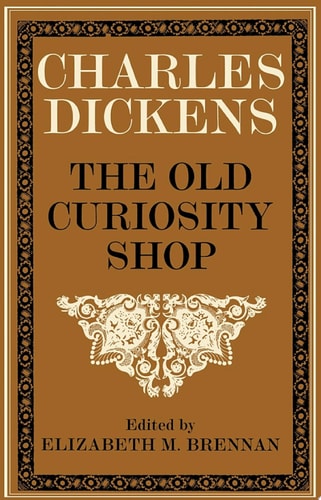
The Old Curiosity Shop
0
0
As an Amazon Associate and affiliate partner, Menrva Books earns from qualifying purchases. Learn more
Author Description
The Old Curiosity Shop was expanded from a short tale to save Dickens's failing periodical Master Humphrey's Clock (1840-1); it is the first of his novels of which the complete manuscript, many corrected proofs, and some working notes survive. This makes it uniquely interesting to both the textual critic and general reader. Forster's Life of Dickens played down the novelist's dependence on his friend's help, but the proofs reveal at first hand the nature of Forster's assistance as well as Dickens's own practice. In conjunction with the manuscript, which contains two previously unprinted notes to his publisher, they show Dickens dealing with the unexpected demands of weekly serialization of an unplanned, full-length novel. This is most obvious as he approaches the death of Little Nell, in whose fate both he and his readers became emotionally involved. This is the first edition to benefit from the recent revelation of material which Dickens had himself obscured or discarded on manuscript versos, and the first to scrutinize the importance and impact of the wood engravings dropped into the text.
Menrva's Summary
THE PULSE
Little Nell Trent and her grandfather flee their home in London to escape the predatory moneylender Daniel Quilp. Driven by the need to protect her grandfather from his own gambling addiction and the machinations of the grotesque Quilp, Nell navigates a landscape of poverty and exploitation. The narrative follows their flight through the English countryside, presenting a series of encounters with eccentric characters who represent both the benevolence and the cruelty of society. Dickens utilizes a third-person omniscient perspective to weave together the protagonists' struggle with the subplots of those pursuing them, maintaining a high-stakes atmosphere throughout the serialized chapters.
INSIDE THE PAGES
- Episodic narrative structure typical of weekly serialization
- Use of grotesque caricature to represent moral extremes
- Exploration of the divide between urban industrial decay and rural idealism
- Integration of social commentary regarding Victorian poverty
- Frequent shifts in tone between comedic relief and tragic sentimentality
- Detailed descriptions of interior spaces and architectural settings
- Character-driven plot progression focused on the vulnerability of the innocent
- Symbolic use of the shop as a representation of the past and mortality
THE COLLECTIVE ECHO
Readers frequently highlight the stark contrast between the villainous Quilp and the saintly Little Nell as a defining feature of the work. Discussion often centers on the pacing of the novel, which reflects the pressures of its original weekly publication schedule. Critics often examine the author's ability to manipulate reader sentiment, particularly regarding the conclusion of the protagonist's arc. The work remains a primary subject for those interested in the evolution of the Victorian novel and the mechanics of serialized storytelling.
Page Count:
742
Publication Date:
1997-01-01
Publisher:
Clarendon Press
ISBN-10:
0191500402
ISBN-13:
9780191500404
Classic Literature
Serialized fiction
Victorian
England
English
English & College Success
Social Realism