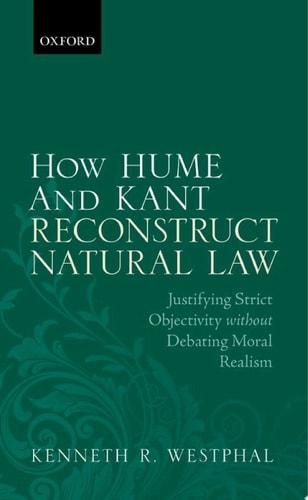
How Hume and Kant Reconstruct Natural Law: Justifying Strict Objectivity without Debating Moral Realism
0
0
As an Amazon Associate and affiliate partner, Menrva Books earns from qualifying purchases. Learn more
Author Description
Kenneth R. Westphal presents an original interpretation of Hume's and Kant's moral philosophies, the differences between which are prominent in current philosophical accounts. Westphal argues that focussing on these differences, however, occludes a decisive, shared achievement: a distinctive constructivist method to identify basic moral principles and to justify their strict objectivity, without invoking moral realism nor moral anti-realism or irrealism. Their constructivism is based on Hume's key insight that 'though the laws of justice are artificial, they are not arbitrary'. Arbitrariness in basic moral principles is avoided by starting with fundamental problems of social coördination which concern outward behaviour and physiological needs; basic principles of justice are artificial because solving those problems does not require appeal to moral realism (nor to moral anti-realism). Instead, moral cognitivism is preserved by identifying sufficient justifying reasons, which can be addressed to all parties, for the minimum sufficient legitimate principles and institutions required to provide and protect basic forms of social coördination (including verbal behaviour). Hume first develops this kind of constructivism for basic property rights and for government. Kant greatly refines Hume's construction of justice within his 'metaphysical principles of justice', whilst preserving the core model of Hume's innovative constructivism. Hume's and Kant's constructivism avoids the conventionalist and relativist tendencies latent if not explicit in contemporary forms of moral constructivism.
Menrva's Summary
THE THESIS
This work investigates how David Hume and Immanuel Kant independently developed a constructivist method to establish the strict objectivity of moral principles without relying on the frameworks of moral realism or anti-realism. Kenneth R. Westphal, a scholar of Kantian and Humean ethics, argues that traditional interpretations overemphasize the differences between these two philosophers. By focusing on their shared approach to social coordination and physiological necessity, Westphal demonstrates how both thinkers successfully grounded moral cognitivism in artificial yet non-arbitrary principles of justice.
THE SCOPE MAP
What You Will Find
- A comparative analysis of Hume's theory of property rights and government alongside Kant's metaphysical principles of justice.
- A detailed examination of the constructivist methodology used to solve problems of social coordination.
- An argument for how moral objectivity can be maintained through justifying reasons accessible to all parties.
Scope Limits
- The text does not provide a general history of moral philosophy beyond the specific constructivist projects of Hume and Kant.
- It does not engage with contemporary meta-ethical debates outside the specific context of the author's constructivist thesis.
THE AUTHORITY PERSPECTIVE
Scholars recognize this text as a significant contribution to the re-evaluation of the relationship between Humean and Kantian ethics. Readers frequently note the academic density of the prose, which is intended for advanced students and professionals in the field of moral philosophy.
Page Count:
268
Publication Date:
2016-01-01
Publisher:
Clarendon Press
ISBN-10:
0191064122
ISBN-13:
9780191064128
Philosophy
History & Surveys
Natural law
Moral Philosophy
Philosophy history
Ethics
Political Philosophy
Community Tags
Similar Books