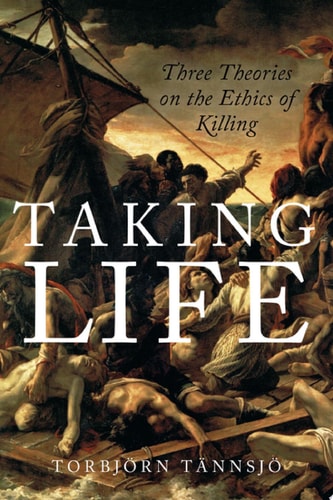
Taking Life: Three Theories on the Ethics of Killing
0
0
As an Amazon Associate and affiliate partner, Menrva Books earns from qualifying purchases. Learn more
Author Description
When and why is it right to kill? When and why is it wrong? Torbjörn Tännsjö examines three theories on the ethics of killing in this book: deontology, a libertarian moral rights theory, and utilitarianism. The implications of each theory are worked out for different kinds of killing: trolley-cases, murder, capital punishment, suicide, assisted death, abortion, killing in war, and the killing of animals. These implications are confronted with our intuitions in relation to them, and our moral intuitions are examined in turn. Only those intuitions that survive an understanding of how we have come to hold them are seen as 'considered' intuitions. The idea is that the theory that can best explain the content of our considered intuitions gains inductive support from them. We must transcend our narrow cultural horizons and avoid certain cognitive mistakes in order to hold considered intuitions. In this volume, suitable for courses in ethics and applied ethics, Tännsjö argues that in the final analysis utilitarianism can best account for, and explain, our considered intuitions about all these kinds of killing.
Menrva's Summary
THE THESIS
This book investigates the moral permissibility of killing by evaluating three distinct ethical frameworks: deontology, libertarian moral rights theory, and utilitarianism. Torbjörn Tännsjö, a professor of practical philosophy, utilizes these frameworks to analyze various scenarios involving the termination of life. By contrasting theoretical implications with human moral intuitions, the author argues that utilitarianism provides the most robust explanation for our considered moral judgments regarding the ethics of killing.
THE SCOPE MAP
What You Will Find
- Comparative analysis of deontology, libertarianism, and utilitarianism
- Application of ethical theories to trolley problems, capital punishment, and war
- Examination of the ethics surrounding abortion, suicide, and animal rights
- A methodology for refining raw moral intuitions into 'considered' intuitions
Scope Limits
- Does not provide a comprehensive legal analysis of homicide laws
- Does not address theological or religious arguments against killing
THE AUTHORITY PERSPECTIVE
Experts and educators frequently identify this text as a foundational resource for undergraduate courses in applied ethics due to its clear, structured approach to complex moral dilemmas. Readers often note the analytical rigor of the prose, which effectively bridges abstract philosophical theory with concrete, real-world ethical problems.
Page Count:
328
Publication Date:
2015-01-01
Publisher:
Oxford University Press
ISBN-10:
0190457716
ISBN-13:
9780190457716
Philosophy
Non-Fiction
Moral Philosophy
Ethics
Applied ethics
Justification
Community Tags
Similar Books