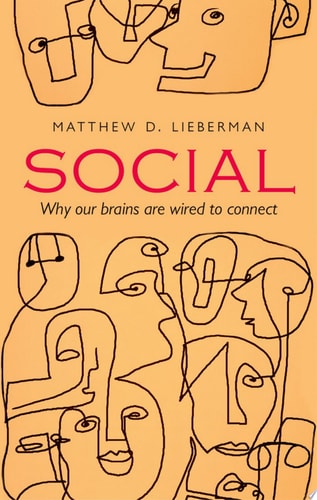
Social: Why Our Brains Are Wired to Connect
0
0
As an Amazon Associate and affiliate partner, Menrva Books earns from qualifying purchases. Learn more
Author Description
Why Are We Influenced By The Behaviour Of Complete Strangers? Why Does The Brain Register Similar Pleasure When I Perceive Something As 'fair' Or When I Eat Chocolate? Why Can We Be So Profoundly Hurt By Bereavement? What Are The Evolutionary Benefits Of These Traits? The Young Discipline Of 'social Cognitive Neuroscience' Has Been Exploring This Fascinating Interface Between Brain Science And Human Behaviour Since The Late 1990s. Now One Of Its Founding Pioneers, Matthew D. Lieberman, Presents The Discoveries That He And Fellow Researchers Have Made. Using Fmri Scanning And A Range Of Other Techniques, They Have Been Able To See That The Brain Responds To Social Pain And Pleasure The Same Way As Physical Pain And Pleasure; And That Unbeknown To Ourselves, We Are Constantly 'mindreading' Other People So That We Can Fit In With Them. It Is Clear That Our Brains Are Designed Respond To And Be Influenced By Others. For Good Evolutionary Reasons, He Argues, We Are Wired To Be Social. The Implications Are Numerous And Profound. Do We Have To Rethink What We Understand By Identity, And Free Will? How Can Managers Improve The Way Their Teams Relate And Perform? Could We Organize Large Social Institutions In Ways That Would Work Far Better? And Could There Be Whole New Methods Of Education?
Menrva's Summary
THE THESIS
This book investigates the fundamental question of why human beings are biologically wired for social connection and how our brains process social experiences as physical realities. Matthew D. Lieberman, a pioneer in the field of social cognitive neuroscience, synthesizes decades of research to argue that our need for social interaction is not merely a cultural preference but a primary evolutionary drive. By examining the neural mechanisms behind social pain, pleasure, and empathy, he presents a framework that redefines human identity and institutional organization through the lens of our inherent social nature.
THE SCOPE MAP
What You Will Find
- Analysis of the neural overlap between social pain and physical pain
- Exploration of the 'mindreading' capacity that facilitates social integration
- Discussion on the evolutionary advantages of social cooperation
- Applications of social neuroscience in management, education, and institutional design
Scope Limits
- Does not provide a comprehensive history of general neuroscience
- Does not offer a clinical manual for treating psychological disorders
THE AUTHORITY PERSPECTIVE
Experts recognize this work as a foundational text for understanding the biological basis of social behavior. Readers frequently note the accessibility of the prose despite the technical nature of the fMRI research presented.
Page Count:
384
Publication Date:
2013-01-01
Publisher:
Oup Oxford
ISBN-10:
0191503576
ISBN-13:
9780191503573
Science
Psychology
Action
Neuroscience
Social Science
Evolutionary Psychology