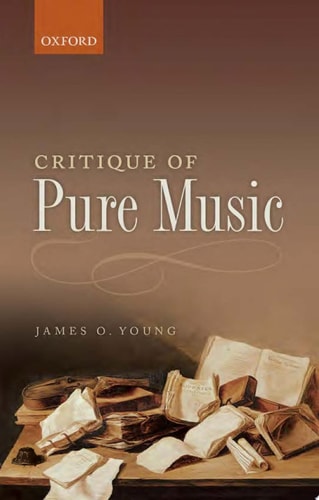
Critique of Pure Music
0
0
As an Amazon Associate and affiliate partner, Menrva Books earns from qualifying purchases. Learn more
Author Description
Why do we value music? Many people report that listening to music is one of life's most rewarding activities. In Critique of Pure Music, James O. Young seeks to explain why this is so. Formalists tell us that music is appreciated as pure, contentless form. On this view, listeners receive pleasure, or a pleasurable 'musical' emotion, when they explore the abstract patterns found in music. Music, formalists believe, does not arouse ordinary emotions such as joy, melancholy or fear, nor can it represent emotion or provide psychological insight. Young holds that formalists are wrong on all counts. Drawing upon the latest psychological research, he argues that music is expressive of emotion by resembling human expressive behaviour. By resembling human expressive behaviour, music is able to arouse ordinary emotions in listeners. This, in turn, makes possible the representation of emotion by music. The representation of emotion in music gives music the capacity to provide psychological insight-into the emotional lives of composers, and the emotional lives of individuals from a variety of times and places. And it is this capacity of music to provide psychological insight which explains a good deal of the value of music, both vocal and purely instrumental. Without it, music could not be experienced as profound. Philosophers, psychologists, musicians, musicologists, and music lovers will all find something of interest in this book.
Menrva's Summary
THE THESIS
What is the source of music's value and its capacity to provide profound psychological insight? James O. Young, a philosopher specializing in aesthetics, challenges the formalist perspective that music is merely an abstract, contentless form. By synthesizing contemporary psychological research with philosophical inquiry, Young argues that music functions as an expressive medium that mirrors human behavior, thereby enabling the communication of genuine emotion and the provision of psychological insight into the human condition.
THE SCOPE MAP
What You Will Find
- A critique of formalist theories regarding musical appreciation.
- An analysis of how music resembles human expressive behavior.
- A framework for understanding how music arouses and represents ordinary emotions.
- An exploration of the link between musical expression and psychological insight.
Scope Limits
- The text focuses primarily on the philosophical and psychological dimensions of musical value rather than technical music theory or historical musicology.
THE AUTHORITY PERSPECTIVE
Scholars and musicologists frequently note the book's rigorous engagement with both analytic philosophy and empirical psychology. Experts highlight this as a significant contribution to the philosophy of music that successfully bridges the gap between abstract aesthetic theory and the lived experience of listeners.
Page Count:
224
Publication Date:
2014-01-01
Publisher:
OUP Oxford
ISBN-10:
0191505188
ISBN-13:
9780191505188
Non-Fiction
Philosophy
Music
Musicology
Aesthetics
Community Tags
Other Editions(2)
Similar Books