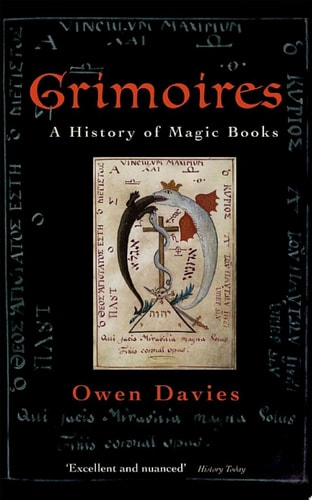
Grimoires: A History of Magic Books
0
0
As an Amazon Associate and affiliate partner, Menrva Books earns from qualifying purchases. Learn more
Author Description
What is a grimoire? The word has a familiar ring to many people, particularly as a consequence of such popular television dramas as Buffy the Vampire Slayer and Charmed. But few people are sure exactly what it means. Put simply, grimoires are books of spells that were first recorded in the Ancient Middle East and which have developed and spread across much of the Western Hemisphere and beyond over the ensuing millennia. At their most benign, they contain charms and remedies for natural and supernatural ailments and advice on contacting spirits to help find treasures and protect from evil. But at their most sinister they provide instructions on how to manipulate people for corrupt purposes and, worst of all, to call up and make a pact with the Devil. Both types have proven remarkably resilient and adaptable and retain much of their relevance and fascination to this day. But the grimoire represents much more than just magic. To understand the history of grimoires is to understand the spread of Christianity, the development of early science, the cultural influence of the print revolution, the growth of literacy, the impact of colonialism, and the expansion of western cultures across the oceans. As this book richly demonstrates, the history of grimoires illuminates many of the most important developments in European history over the last two thousand years.
Menrva's Summary
THE THESIS
This work investigates the historical evolution, cultural significance, and enduring influence of grimoires as both practical manuals and symbolic artifacts within Western society. Professor Owen Davies, a specialist in the history of magic and witchcraft, utilizes a vast array of primary source material, including surviving manuscripts and early printed texts, to trace the development of these spellbooks. He argues that grimoires serve as a unique lens through which to view the intersection of religious expansion, the rise of literacy, and the development of early scientific thought over two millennia.
THE SCOPE MAP
What You Will Find
- A chronological analysis of spellbooks from the Ancient Middle East to the modern era
- Examination of the transition from handwritten manuscripts to mass-produced printed volumes
- Exploration of the social and cultural contexts of magic, including the influence of Christianity and colonialism
Scope Limits
- The text focuses primarily on the Western tradition and does not provide an exhaustive global survey of all magical literature
- It does not function as a practical guide for performing rituals or spells
THE AUTHORITY PERSPECTIVE
Scholars and historians recognize this text as a definitive academic survey of the subject, praised for its rigorous research and accessible prose. Readers frequently note that the book successfully bridges the gap between specialized academic inquiry and general interest history.
Page Count:
380
Publication Date:
2010-01-01
Publisher:
OUP Oxford
ISBN-10:
0191509248
ISBN-13:
9780191509247
History
Religion
Charms
Cultural History
Occultism
Magic
Body Mind Spirit
Folklore
Occult
Magic history
Community Tags
Similar Books