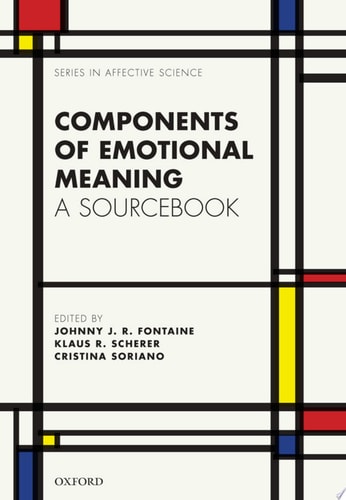
Components of Emotional Meaning: A Sourcebook
0
0
As an Amazon Associate and affiliate partner, Menrva Books earns from qualifying purchases. Learn more
Author Description
Publications On Emotion (and The Affective Sciences In General) Have Exploded In The Last Decade. Numerous Research Teams And Individual Scholars From Many Different Disciplines Have Published Research Papers Or Books About Many Different Aspects Of Emotions And Their Role In Behaviour And Society. However, One Aspect Of Emotional Research That Has Been Somewhat Neglected, Is The Way In Which Emotional Terms Translate Into Other Languages. When Using Terms Like Anger, Sadness, Fear, Disgust, And Joy For So-called Basic Emotions, As Well As Terms Like Shame, Guilt, Pride, Regret And Contempt For More Complex Emotions, It Is Naturally Assumed That The Emotion Terms Used For Research In The Native Language Of The Researchers And Translated Into English Are Completely Equivalent In Meaning. However, This Is Not Generally The Case. In Many Cases There Is No Direct One To One Relationship Between An English Term And A Term In An Alternative Language. In Fact, There Can Be Significant Differences In The Way That These Seemingly Similar Emotional Terms Can Be Applied Across Various Languages, With Important Implications For How We Review And Appraise This Work. This Book Presents An Extensive Cross-cultural And Cross-linguistic Review Of The Meaning Of Emotion Words, Adopting A Novel Methodological Approach. Based On The Component Process Model, The Authors Developed A New Instrument To Assess The Meaning Of Emotion Terms. This Instrument, The Grid Questionnaire, Consists Of A Grid Of 24 Emotion Terms Spanning The Emotion Domain And 142 Emotion Features That Operationalize Five Emotion Components (appraisals, Bodily Reactions, Expressions, Action Tendencies, And Feelings). For The Operationalization Of These Five Emotion Components, Very Different Emotion Models From The Western And The Cultural-comparative Emotion Literature Were Taken Into Account. 'components Of Emotional Meaning' Includes Contributions From Psychological, Cultural-comparative, And Linguistic Perspective
Menrva's Summary
THE THESIS
This book investigates the fundamental assumption that emotional terms are semantically equivalent across different languages and cultures. The authors, led by experts in affective science and cross-cultural psychology, argue that the translation of emotion words often obscures significant variations in meaning. By utilizing the Component Process Model, they provide a rigorous framework to analyze how emotions are appraised, expressed, and felt globally.
THE SCOPE MAP
What You Will Find
- A comprehensive cross-cultural and cross-linguistic analysis of 24 distinct emotion terms.
- The Grid Questionnaire, a specialized instrument measuring 142 emotion features.
- Operationalization of five core emotion components: appraisals, bodily reactions, expressions, action tendencies, and feelings.
Scope Limits
- The study focuses primarily on the semantic and structural mapping of emotion terms rather than the neurobiological mechanisms of emotion.
- It does not provide an exhaustive dictionary of every emotional term in every language, but rather a methodological framework for comparative analysis.
THE AUTHORITY PERSPECTIVE
Experts recognize this volume as a significant methodological contribution to the field of affective science, particularly for researchers navigating cross-cultural data. Scholars frequently cite the Grid Questionnaire as a standard tool for standardizing emotion research across diverse linguistic populations.
Page Count:
624
Publication Date:
2013-01-01
Publisher:
Oxford University Press
ISBN-10:
0191504777
ISBN-13:
9780191504778
Psychology
Emotion Research
Linguistics
Community Tags
Other Editions(2)
Similar Books









Reader Comments
Share Your Thoughts
No comments yet. Be the first to share your thoughts!