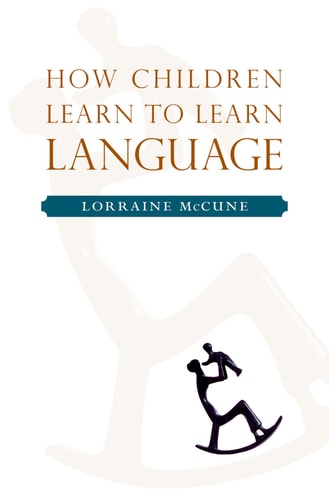
How Children Learn to Learn Language
0
0
As an Amazon Associate and affiliate partner, Menrva Books earns from qualifying purchases. Learn more
Author Description
Studies of language acquisition often assume that children will simply begin to learn language, without questioning what sets the whole process in motion. In How Children Learn to Learn Language, Lorraine McCune thoroughly examines the often-neglected topic of how children discover the possibility of language and demonstrates that pre-language development involves a dynamic system of social, cognitive, and vocal variables that come together to enable the transition to referential language. The relationship with a caregiver is integral to this development because language is a system of symbolic communication that can emerge only with children's recognition that they are separate from others. McCune sees language learning as constructed equally from needing to develop meanings and learning to produce the sound sequences that represent them. In order for this dual construction to be effective, however, children must discover their capacity to refer to objects and events in the world by having their internal states of focused attention accompanied by an autonomic, physiologically based vocalization, which is the grunt that results from physical or mental effort. When the grunt is intensified and directed at a conversational partner, as when children attempt to convey an internal state, it becomes their first protoword. How Children Learn to Learn Language will be a valuable resource on pre-language development for students and researchers in developmental psychology.
Menrva's Summary
THE THESIS
This book investigates the foundational mechanisms that enable children to transition from pre-linguistic states to the use of referential language. Lorraine McCune, an expert in developmental psychology, challenges the assumption that language acquisition is an automatic process. She argues that language emerges from a complex interplay of social, cognitive, and vocal variables, specifically highlighting the role of caregiver interaction and the child's developing sense of self. The text posits that the discovery of language is a dual construction involving both the development of meaning and the mastery of symbolic sound sequences.
THE SCOPE MAP
What You Will Find
- Analysis of the transition from pre-language vocalizations to symbolic communication.
- Examination of the role of caregiver-child relationships in linguistic development.
- Theoretical framework regarding the emergence of protowords from effort-based grunts.
- Exploration of the cognitive requirement for children to recognize their separation from others.
THE AUTHORITY PERSPECTIVE
Experts in developmental psychology recognize this work as a significant contribution to the study of pre-linguistic development. Researchers frequently cite the text for its detailed examination of the physiological and social precursors to formal language acquisition.
Page Count:
288
Publication Date:
2008-01-03
Publisher:
Oxford University Press
ISBN-10:
0195177878
ISBN-13:
9780195177879
Psychology
Linguistics
Education
Developmental Psychology
Community Tags
Similar Books