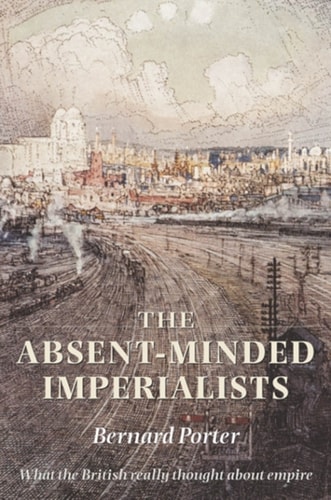
The Absent-Minded Imperialists: Empire, Society, and Culture in Britain
0
0
As an Amazon Associate and affiliate partner, Menrva Books earns from qualifying purchases. Learn more
Author Description
The British empire was a huge enterprise. To foreigners it more or less defined Britain in the nineteenth and early twentieth centuries. Its repercussions in the wider world are still with us today. It also had a great impact on Britain herself: for example, on her economy, security, population, and eating habits. One might expect this to have been reflected in her society and culture. Indeed, this has now become the conventional wisdom: that Britain was steeped in imperialism domestically, which affected (or infected) almost everything Britons thought, felt, and did. This is the first book to examine this assumption critically against the broader background of contemporary British society. Bernard Porter, a leading imperial historian, argues that the empire had a far lower profile in Britain than it did abroad. Many Britons could hardly have been aware of it for most of the nineteenth century and only a small number was in any way committed to it. Between these extremes opinions differed widely over what was even meant by the empire. This depended largely on class, and even when people were aware of the empire, it had no appreciable impact on their thinking about anything else. Indeed, the influence far more often went the other way, with perceptions of the empire being affected (or distorted) by more powerful domestic discourses. Although Britain was an imperial nation in this period, she was never a genuine imperial society. As well as showing how this was possible, Porter also discusses the implications of this attitude for Britain and her empire, and for the relationship between culture and imperialism more generally, bringing his study up to date by including the case of the present-day USA.
Menrva's Summary
THE THESIS
This book investigates the extent to which the British Empire permeated the domestic society and culture of Britain during the nineteenth and early twentieth centuries. Bernard Porter, a prominent historian of the British Empire, challenges the prevailing academic consensus that imperialism was a pervasive force in the daily lives and consciousness of the British public. By analyzing social, economic, and cultural data, Porter argues that the empire remained a peripheral concern for the majority of the population, suggesting that domestic discourses exerted more influence on imperial perceptions than vice versa.
THE SCOPE MAP
What You Will Find
- Analysis of nineteenth and early twentieth-century British social and cultural history
- Examination of class-based variations in imperial awareness
- Comparative study of domestic versus colonial perspectives
- Discussion of the relationship between imperial policy and national identity
Scope Limits
- Does not provide an exhaustive survey of every colonial administrative policy
- Focuses primarily on the domestic British experience rather than the lived reality of colonial subjects
THE AUTHORITY PERSPECTIVE
Historians and scholars frequently cite this work as a significant counter-narrative to the cultural turn in imperial studies. Readers often note the academic rigor and the provocative nature of Porter's argument regarding the limited domestic impact of the British Empire.
Page Count:
498
Publication Date:
2005-01-01
Publisher:
Oxford University Press
ISBN-10:
0191513415
ISBN-13:
9780191513411
History
Imperialism
Cultural History
Great Britain
Colonialism
Sociology
Public opinion
British History
European History
Community Tags
Similar Books