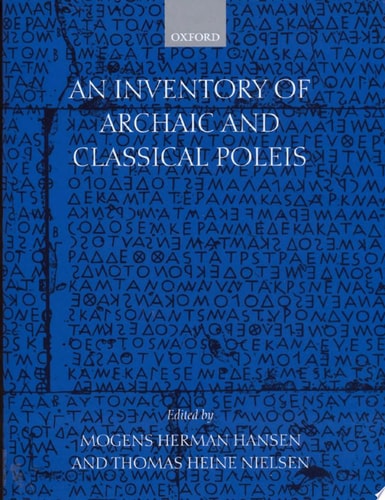
An Inventory of Archaic and Classical Poleis: An Investigation Conducted by The Copenhagen Polis Centre for the Danish National Research Foundation
0
0
As an Amazon Associate and affiliate partner, Menrva Books earns from qualifying purchases. Learn more
Author Description
This is the first ever documented study of the 1,035 identifiable Greek city states (poleis) of the Archaic and Classical periods (c.650-325 BC). Previous studies of the Greek polis have focused on Athens and Sparta, and the result has been a view of Greek society dominated by Sophokles', Plato's, and Demosthenes' view of what the polis was. This study includes descriptions of Athens and Sparta, but its main purpose is to explore the history and organization of the thousand other city states. The main part of the book is a regionally organized inventory of all identifiable poleis covering the Greek world from Spain to the Caucasus and from the Crimea to Libya. This inventory is the work of 47 specialists, and is divided into 46 chapters, each covering a region. Each chapter contains an account of the region, a list of second-order settlements, and an alphabetically ordered description of the poleis. This description covers such topics as polis status, territory, settlement pattern, urban centre, city walls and monumental architecture, population, military strength, constitution, alliance membership, colonization, coinage, and Panhellenic victors. The first part of the book is a description of the method and principles applied in the construction of the inventory and an analysis of some of the results to be obtained by a comparative study of the 1,035 poleis included in it. The ancient Greek concept of polis is distinguished from the modern term `city state', which historians use to cover many other historic civilizations, from ancient Sumeria to the West African cultures absorbed by the nineteenth-century colonializing powers. The focus of this project is what the Greeks themselves considered a polis to be.
Menrva's Summary
THE THESIS
This volume investigates the structural and historical diversity of the 1,035 identifiable Greek city-states (poleis) during the Archaic and Classical periods. Mogens Herman Hansen and Thomas Heine Nielsen, representing the Copenhagen Polis Centre, move beyond the traditional focus on Athens and Sparta to provide a comprehensive, data-driven analysis of the entire Greek world. By establishing rigorous criteria for what constituted a polis in the eyes of the Greeks themselves, the authors provide a framework for understanding the political, social, and architectural variations across the Mediterranean and Black Sea regions.
THE SCOPE MAP
What You Will Find
- A regional inventory of 1,035 poleis spanning from Spain to the Caucasus and Crimea to Libya.
- Detailed entries for each city-state covering status, territory, population, military strength, and constitutional form.
- A methodological introduction defining the parameters of the polis concept versus modern city-state definitions.
- Contributions from 47 specialized scholars organized into 46 regional chapters.
Scope Limits
- The study is strictly limited to the Archaic and Classical periods, specifically c. 650-325 BC.
- It does not provide exhaustive narrative histories of individual cities, focusing instead on comparative structural data.
THE AUTHORITY PERSPECTIVE
Scholars and historians regard this work as the definitive reference text for the study of the ancient Greek polis. Readers frequently note the immense academic density and the meticulous nature of the regional data provided by the contributors.
Page Count:
1414
Publication Date:
2004-01-01
Publisher:
OUP Oxford
ISBN-10:
0191518255
ISBN-13:
9780191518256
History
Ancient Greece
Reference
Archaeology
Ancient History
Community Tags
Similar Books