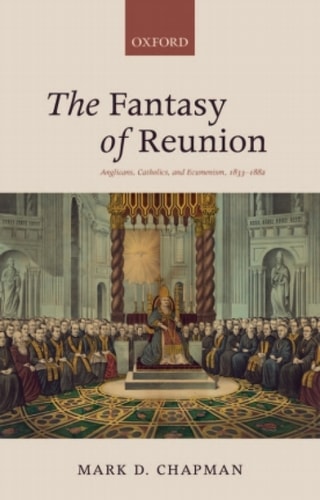
The Fantasy of Reunion: Anglicans, Catholics, and Ecumenism, 1833-1882
0
0
As an Amazon Associate and affiliate partner, Menrva Books earns from qualifying purchases. Learn more
Author Description
This book discusses the different understandings of 'catholicity' that emerged in the interactions between the Church of England and other churches - particularly the Roman Catholic Church and later the Old Catholic Churches - from the early 1830s to the early 1880s. It presents a pre-history of ecumenism, which isolates some of the most distinctive features of the ecclesiological positions of the different churches as these developed through the turmoil of the nineteenth century. It explores the historical imagination of a range of churchmen and theologians, who sought to reconstruct their churches through an encounter with the past whose relevance for the construction of identity in the present went unquestioned. The past was no foreign country but instead provided solutions to the perceived dangers facing the church of the present. Key protagonists are John Henry Newman and Edward Bouverie Pusey, the leaders of the Oxford Movement, as well as a number of other less well-known figures who made their distinctive mark on the relations between the churches. The key event in reshaping the terms of the debates between the churches was the Vatican Council of 1870, which put an end to serious dialogue for a very long period, but which opened up new avenues for the Church of England and other non-Roman European churches including the Orthodox. In the end, however, ecumenism was halted in the 1880s by an increasingly complex European situation and an energetic expansion of the British Empire, which saw the rise of Pan-Anglicanism at the expense of ecumenism.
Menrva's Summary
THE THESIS
This work investigates how competing definitions of 'catholicity' shaped the ecumenical interactions between the Church of England, the Roman Catholic Church, and Old Catholic movements during the nineteenth century. Mark D. Chapman, a scholar of modern church history, utilizes archival theological debates and historical correspondence to analyze how nineteenth-century churchmen attempted to reconstruct their institutional identities. The book argues that these figures viewed the past as a functional tool for solving contemporary crises, ultimately demonstrating how shifting geopolitical landscapes and the rise of Pan-Anglicanism curtailed early ecumenical efforts.
THE SCOPE MAP
What You Will Find
- Analysis of the Oxford Movement and its primary figures, John Henry Newman and Edward Bouverie Pusey.
- Examination of the impact of the 1870 Vatican Council on inter-church relations.
- Exploration of the transition from ecumenical dialogue to the expansion of British imperial religious identity.
Scope Limits
- The study is strictly confined to the period between 1833 and 1882.
- It does not provide a comprehensive history of all Christian denominations, focusing primarily on the Anglican and Roman Catholic interactions.
THE AUTHORITY PERSPECTIVE
Scholars recognize this text as a rigorous examination of nineteenth-century ecclesiology and the intellectual history of the Oxford Movement. Readers frequently note the academic density of the prose, which provides a specialized look at the theological tensions defining the era.
Page Count:
352
Publication Date:
2014-01-01
Publisher:
OUP Oxford
ISBN-10:
0191511927
ISBN-13:
9780191511929
Religion
History
Special Topics
Anglicanism
Ecclesiastical History
Theology
19th Century
Catholicism
Community Tags
Similar Books