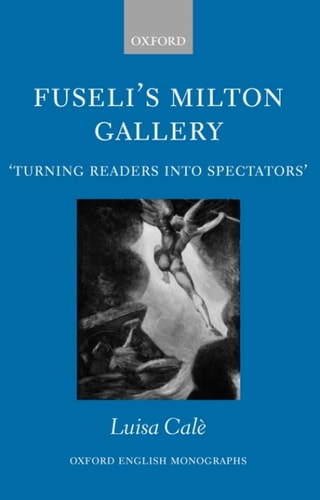
Fuseli's Milton Gallery: Turning Readers into Spectators
0
0
As an Amazon Associate and affiliate partner, Menrva Books earns from qualifying purchases. Learn more
Author Description
Fuseli's Milton Gallery challenges the antipictorial theories and canons of Romantic period culture. Between 1791 and 1799 Swiss painter Henry Fuseli turned Milton's Paradise Lost into a series of 40 pictures. Fuseli's project and other literary galleries developed within an expanding market for illustrated books and a culture of anthologization used to reading British and other 'classics' in terms of the visualization of key moments in the text. Thus transformed into repositories of virtual pictures literary texts became ideal sources of subjects for painters. Illustrating British literature was a way of inventing a national 'grand style' to fit the needs of a consumer society. Cale calls into question the separation of reading and viewing as autonomous aesthetic practices. To 'turn readers into spectators' meant to place readers and reading within the dizzying world of associations offered by an emerging culture of exhibitions. Attending to the energized reading effects developed by Fuseli's Gallery we rediscover a new side of the Romantic imagination which is not the solitary mentalist experience preferred by Wordsworth and Coleridge, nor divorced from the senses, let alone a refuge from the crowded public spaces of the Revolutionary period. Rather, Fuseli's embodied aesthetic exemplifies the associationist psychology espoused by the radical circle convening around the publisher Joseph Johnson, including Joseph Priestley and Mary Wollstonecraft. This book analyses exhibitions as important sites of Romantic sociability and one of many interrelated mediums for the literature, debates and controversies of the Revolutionary period.
Menrva's Summary
THE THESIS
This work investigates how Henry Fuseli’s Milton Gallery challenged the prevailing antipictorial theories of the Romantic period by transforming literary texts into visual spectacles. Luisa Calè, a scholar specializing in Romanticism and visual culture, utilizes historical records of the 1790s art market and the radical intellectual circle surrounding publisher Joseph Johnson to argue that the act of reading was fundamentally reshaped by exhibition culture. She posits that the visualization of literature served as a mechanism for constructing a national aesthetic identity within a burgeoning consumer society.
THE SCOPE MAP
What You Will Find
- Analysis of Henry Fuseli’s 40-painting series based on Milton’s Paradise Lost.
- Examination of the intersection between associationist psychology and exhibition practices.
- Contextualization of the Milton Gallery within the radical political and social debates of the Revolutionary period.
Scope Limits
- The study does not provide a comprehensive biography of Henry Fuseli.
- It does not cover the entirety of the Romantic period’s visual arts, focusing specifically on the phenomenon of literary galleries.
THE AUTHORITY PERSPECTIVE
Scholars and historians of Romanticism frequently cite this text for its rigorous integration of art history and literary theory. Experts highlight the book as a significant contribution to understanding how public exhibition spaces influenced the reception of canonical literature during the late eighteenth century.
Page Count:
273
Publication Date:
2007-01-01
Publisher:
Clarendon Press
ISBN-10:
0191514861
ISBN-13:
9780191514869
Visual Culture
Art History
Romanticism
English & College Success
Literary Criticism
English
British literature
Cultural History
Community Tags
Similar Books