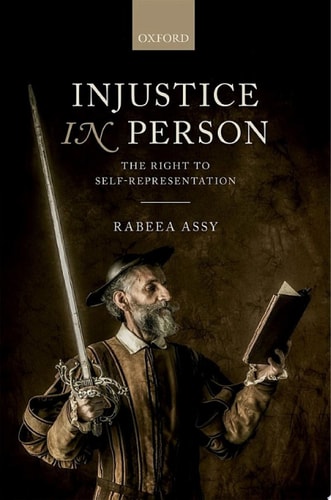
Injustice in Person: The Right to Self-Representation
0
0
As an Amazon Associate and affiliate partner, Menrva Books earns from qualifying purchases. Learn more
Author Description
In common law jurisdictions, litigants are free to choose whether to procure legal representation or litigate in person. There is no formal requirement that civil litigants obtain legal representation, and the court has no power to impose it on them, regardless of whether the litigant has the financial means to hire a lawyer or is capable of conducting litigation effectively. Self-representation is considered indispensable even in circumstances of extreme abuse of process, such as in 'vexatious litigation'. Intriguingly, although self-representation is regarded as sacrosanct in common law jurisdictions, most civil law systems take a diametrically opposite view and impose obligations of legal representation as a condition for conducting civil litigation, except in low-value claims courts or specific tribunals. This disparity presents a conundrum in comparative law: an unfettered freedom to proceed in person is afforded in those legal systems that are more reliant on the litigants' professional skills and whose rules of procedure and evidence are more formal, complex, and adversarial, whereas legal representation tends to be made obligatory in systems that are judge-based and offer more flexible and informal procedures, which would seem, intuitively, to be more conducive to self-representation. In Injustice in Person: The Right to Self Representation, Rabeea Assy assesses the theoretical value of self-representation, and challenges the conventional wisdom that this should be a fundamental right. With a fresh perspective, Assy develops a novel justification for mandatory legal representation, exploring a number of issues such as the requirements placed by the liberal commitment to personal autonomy on the civil justice system; the utility of plain English projects and the extent to which they render the law accessible to lay people; and the idea that a high degree of litigant control over the proceedings enhances litigants' subjective perceptions of procedural fairness
Menrva's Summary
THE THESIS
This book investigates the theoretical validity of the right to self-representation in civil litigation and challenges the assumption that it constitutes a fundamental legal right. Rabeea Assy, a legal scholar, examines the historical and procedural foundations of common law versus civil law systems. He argues that the current emphasis on personal autonomy in legal proceedings often undermines the efficacy of the justice system, proposing instead a framework that favors mandatory legal representation to ensure procedural fairness.
THE SCOPE MAP
What You Will Find
- Comparative analysis between common law and civil law procedural requirements.
- Evaluation of the impact of plain English initiatives on legal accessibility.
- Theoretical exploration of personal autonomy within the civil justice system.
Scope Limits
- The text does not provide a practical guide for individuals representing themselves in court.
- It does not cover criminal law proceedings, focusing exclusively on civil litigation.
THE AUTHORITY PERSPECTIVE
Legal scholars and practitioners recognize this work as a significant contribution to the debate on access to justice and procedural reform. Experts frequently note the academic rigor of the author's argument, which challenges long-standing assumptions about the necessity of self-representation in adversarial systems.
Page Count:
232
Publication Date:
2015-01-01
Publisher:
OUP Oxford
ISBN-10:
0191511145
ISBN-13:
9780191511141
Civil Procedure
Comparative Law
Jurisprudence
Law
Professional Career & Trade
Legal Theory
Community Tags
Similar Books