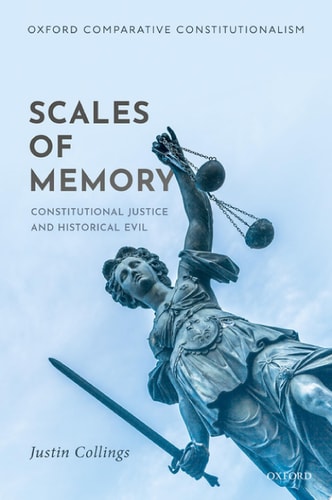
Scales of Memory: Constitutional Justice and Historical Evil
0
0
As an Amazon Associate and affiliate partner, Menrva Books earns from qualifying purchases. Learn more
Author Description
Since the Second World War, constitutional justice has spread through much of the democratic world. Often it has followed in the wake of national calamity and historical evil - whether fascism or communism, colonialism or apartheid. Unsurprisingly, the memory of such evils plays a prominent role in constitutional adjudication. This book explores the relationship between constitutional interpretation and the memory of historical evil. Specifically, it examines how the constitutional courts of the United States, Germany, and South Africa have grappled, respectively, with the legacies of slavery, Nazism, and apartheid. Most courts invoke historical evil through either the parenthetical or the redemptive mode of constitutional memory. The parenthetical framework views the evil era as exceptional - a baleful aberration from an otherwise noble and worthy constitutional tradition. Parenthetical jurisprudence reaches beyond the evil era toward stable and enduring values. It sees the constitutional response to evil as restorative rather than revolutionary - a return to and reaffirmation of older traditions. The redemptive mode, by contrast, is more aggressive. Its aim is not to resume a venerable tradition but to reverse recent ills. Its animating spirit is not restoration, but antithesis. Its aim is not continuity with deeper pasts, but a redemptive future stemming from a stark, complete, and vivid rupture. This book demonstrates how, across the three jurisdictions, the parenthetical mode has often accompanied formalist and originalist approaches to constitutional interpretation, whereas the redemptive mode has accompanied realist and purposive approaches. It also shows how, within the three jurisdictions, the parenthetical mode of memory has consistently predominated in American constitutional jurisprudence; the redemptive mode in South African jurisprudence; and a hybrid, parenthetical-redemptive mode in German constitutional jurisprudence.
Menrva's Summary
THE THESIS
This book investigates how constitutional courts navigate the memory of historical evil to shape contemporary legal interpretation and judicial philosophy. Justin Collings, a legal scholar, utilizes a comparative framework to analyze the jurisprudence of the United States, Germany, and South Africa. He argues that courts typically employ either a 'parenthetical' mode, which treats historical trauma as an aberration to be overcome by returning to older traditions, or a 'redemptive' mode, which seeks a complete rupture from the past to build a new constitutional future.
THE SCOPE MAP
What You Will Find
- Comparative analysis of constitutional adjudication in the United States, Germany, and South Africa.
- A dual-framework model for understanding judicial memory: the parenthetical and redemptive modes.
- Examination of how historical legacies of slavery, Nazism, and apartheid influence modern legal reasoning.
- Correlation between judicial memory modes and interpretive styles like originalism versus purposivism.
Scope Limits
- The study does not provide an exhaustive survey of all global constitutional systems.
- It does not focus on legislative or executive responses to historical evil, concentrating strictly on the judiciary.
THE AUTHORITY PERSPECTIVE
Legal scholars and practitioners identify this work as a significant contribution to the field of comparative constitutionalism. Experts frequently note the clarity with which Collings categorizes complex judicial behaviors, making it a valuable resource for understanding the intersection of law, history, and collective memory.
Page Count:
364
Publication Date:
2021-01-01
Publisher:
OUP Oxford
ISBN-10:
0192602586
ISBN-13:
9780192602589
History
Law
Professional Career & Trade
Jurisprudence
Constitutional Law
Comparative Law
Community Tags
Similar Books