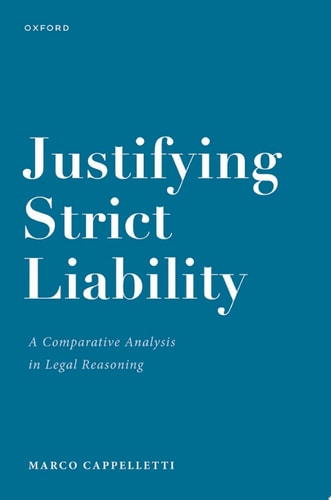
Justifying Strict Liability: A Comparative Analysis in Legal Reasoning
0
0
As an Amazon Associate and affiliate partner, Menrva Books earns from qualifying purchases. Learn more
Author Description
The imposition of strict liability in tort law is controversial, and its theoretical foundations are the object of vigorous debate. Why do or should we impose strict liability on employers for the torts committed by their employees, or on a person for the harm caused by their children, animals, activities, or things? In responding to this type of questions, legal actors rely on a wide variety of justifications. Justifying Strict Liability explores, in a comparative perspective, the most significant arguments that are put forward to justify the imposition of strict liability in four legal systems, two common law, England and the United States, and two civil law, France and Italy. These justifications include: risk, accident avoidance, the 'deep pockets' argument, loss-spreading, victim protection, reduction in administrative costs, and individual responsibility. By looking at how these arguments are used across the four legal systems, this book considers a variety of patterns which characterise the reasoning on strict liability. The book also assesses the justificatory weight of the arguments, showing that these can assume varying significance in the four jurisdictions and that such variations reflect different views as to the values and goals which inspire strict liability and tort law more generally. Overall, the book seeks to improve our understanding of strict liability, to shed light on the justifications for its imposition, and to enhance our understanding of the different tort cultures featuring in the four legal systems studied.
Menrva's Summary
THE THESIS
This book investigates the theoretical foundations and justificatory arguments used to support the imposition of strict liability within tort law across diverse legal systems. Marco Cappelletti, a legal scholar, examines how different jurisdictions rationalize liability without fault, drawing upon a comparative analysis of common law and civil law traditions. The work evaluates the weight and application of various justifications, such as risk allocation and loss-spreading, to reveal the underlying values and goals of contemporary tort systems.
THE SCOPE MAP
What You Will Find
- Comparative analysis of strict liability in England, the United States, France, and Italy
- Examination of justifications including risk, accident avoidance, and the deep pockets argument
- Assessment of the justificatory weight of arguments across different legal cultures
Scope Limits
- Does not provide a comprehensive history of every tort doctrine
- Focuses primarily on the four specified jurisdictions rather than a global survey of all legal systems
THE AUTHORITY PERSPECTIVE
Legal scholars and practitioners view this work as a significant contribution to comparative tort theory. Readers frequently note the academic density of the prose, which is tailored for those with a background in legal reasoning and jurisprudence.
Page Count:
381
Publication Date:
2022-01-01
Publisher:
OUP Oxford
ISBN-10:
0192676075
ISBN-13:
9780192676078
Jurisprudence
Legal Theory
Tort Law
Comparative Law
Law
Professional Career & Trade
Community Tags
Similar Books