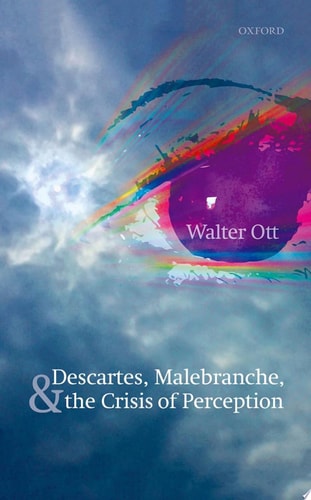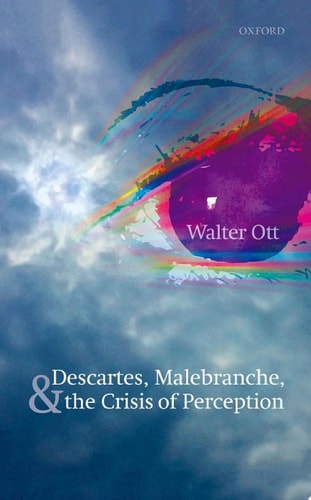
Descartes, Malebranche, and the Crisis of Perception
0
0
As an Amazon Associate and affiliate partner, Menrva Books earns from qualifying purchases. Learn more
Author Description
The seventeenth century witnesses the demise of two core doctrines in the theory of perception: naïve realism about color, sound, and other sensible qualities and the empirical theory, drawn from Alhacen and Roger Bacon, which underwrote it. This created a problem for seventeenth century philosophers: how is that we use qualities such as color, feel, and sound to locate objects in the world, even though these qualities are not real? Ejecting such sensible qualities from the mind-independent world at once makes for a cleaner ontology, since bodies can now be understood in purely geometrical terms, and spawns a variety of fascinating complications for the philosophy of perception. If sensible qualities are not part of the mind-independent world, just what are they, and what role, if any, do they play in our cognitive economy? We seemingly have to use color to visually experience objects. Do we do so by inferring size, shape, and motion from color? Or is it a purely automatic operation, accomplished by divine decree? This volume traces the debate over perceptual experience in early modern France, covering such figures as Antoine Arnauld, Robert Desgabets, and Pierre-Sylvain Régis alongside their better-known countrymen René Descartes and Nicolas Malebranche.
Menrva's Summary
THE THESIS
This work investigates how seventeenth-century philosophers reconciled the removal of sensible qualities from the physical world with the human reliance on those same qualities for perception. Walter Ott, a scholar of early modern philosophy, examines the ontological shift that occurred when color, sound, and texture were reclassified as non-physical entities. He analyzes how this transition forced thinkers to develop new frameworks to explain the cognitive function of sensory experience within a purely geometrical understanding of matter.
THE SCOPE MAP
What You Will Find
- Analysis of the transition from naïve realism to representationalism in early modern France.
- Examination of the role of divine intervention and automatic cognitive operations in perception.
- Comparative study of major figures including René Descartes, Nicolas Malebranche, Antoine Arnauld, Robert Desgabets, and Pierre-Sylvain Régis.
Scope Limits
- The text focuses primarily on the French philosophical tradition rather than a global history of perception.
- It does not provide a general history of optics or scientific advancement outside of its specific philosophical inquiry.
THE AUTHORITY PERSPECTIVE
Scholars recognize this volume as a rigorous contribution to the study of early modern epistemology and the mechanics of perception. Readers frequently note the academic density of the prose, which is intended for those with a background in seventeenth-century philosophical debates.
Page Count:
258
Publication Date:
2017-01-01
Publisher:
OUP Oxford
ISBN-10:
0192509454
ISBN-13:
9780192509451
Philosophy
Epistemology
Philosophy French
Early Modern
Philosophy history
Metaphysics
History & Surveys
Community Tags
Similar Books