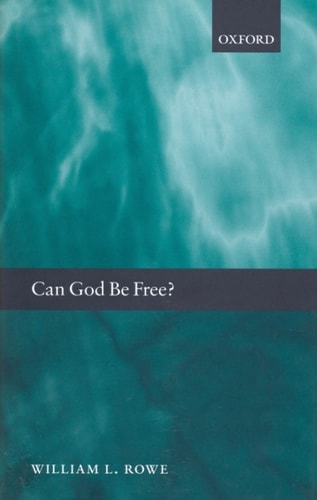
Can God Be Free?
0
0
As an Amazon Associate and affiliate partner, Menrva Books earns from qualifying purchases. Learn more
Author Description
In the three major religions of the West, God is understood to be a being whose goodness, knowledge, and power is such that it is impossible for any being, including God himself, to have a greater degree of goodness, knowledge, and power. This book focuses on God's freedom and praiseworthiness in relation to his perfect goodness. Given his necessary perfections, if there is a best world for God to create he would have no choice other than to create it. For, as Leibniz tells us, 'to do less good than one could is to be lacking in wisdom or in goodness.' But if God could not do otherwise than create the best world, he created the world of necessity, not freely. And, if that is so, it may be argued that we have no reason to be thankful to God for creating us, since, as parts of the best possible world, God was simply unable to do anything other than create us - he created us of necessity, not freely. Moreover, we are confronted with the difficulty of having to believe that this world, with its Holocaust, and innumerable other evils, is the best that an infinitely powerful, infinitely good being could do in creating a world. Neither of these conclusions, taken by itself, seems at all plausible. Yet each conclusion appears to follow from the conception of God now dominant in the great religions of the West. William Rowe presents a detailed study of this important problem, both historically in the writings of Gottfried Leibniz, Samuel Clarke, Thomas Aquinas, and Jonathan Edwards, as well as in the contemporary philosophical literature devoted to the issue. Rowe argues that this problem is more serious than is commonly thought and may require some significant revision in contemporary thinking about the nature of God.
Menrva's Summary
THE THESIS
This book investigates whether the traditional conception of an omnipotent, omniscient, and perfectly good God is logically compatible with the concept of divine freedom. William L. Rowe, a prominent philosopher of religion, examines the tension between the necessity of divine perfection and the capacity for free choice. He argues that if God is bound by his own nature to create the best possible world, then the act of creation becomes a matter of necessity rather than freedom, which complicates traditional notions of divine praiseworthiness and the existence of evil.
THE SCOPE MAP
What You Will Find
- Historical analysis of the works of Leibniz, Clarke, Aquinas, and Edwards
- Examination of the relationship between moral perfection and free will
- Critical evaluation of the 'best of all possible worlds' hypothesis
- Discussion of contemporary philosophical literature regarding divine agency
Scope Limits
- The text does not provide a comprehensive survey of non-Western theological perspectives
- It does not attempt to resolve the problem of evil through theodicy, focusing instead on the logical implications of divine freedom
THE AUTHORITY PERSPECTIVE
Scholars and students of philosophy frequently cite this work as a rigorous and essential contribution to the debate on divine necessity. Readers often note the analytical density of the prose, which requires a strong background in philosophical logic to fully grasp the nuances of the arguments presented.
Page Count:
184
Publication Date:
2004-01-01
Publisher:
Clarendon Press
ISBN-10:
0191513482
ISBN-13:
9780191513480
Philosophy
Philosophy of
Ethics
Theology
Metaphysics