Author Description
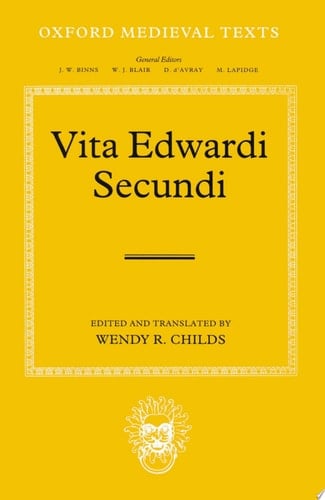
The Vita Edwardi Secundi is the best and most readable of the chronicles of the reign of Edward II, and throws a fascinating light on the world of high politics. The anonymous author was close to the centre of politics, probably a royal clerk, and possibly John Walwayn (or someone with a similar career). His focus is largely on domestic politics and the relationship of the king and his barons, and he records the clashes and reconciliations of the period 1311-22 in valuable detail. He also has much to say on the Scottish war, the appointment of bishops, and the outbreak of the French war. The work ends in the winter of 1325/6 with Queen Isabella's refusal to return from France while Despenser remained with the king. The work is much more than a simple chronicle. The author consciously wrote history and so commented extensively on personalities, and also on causation, motivation, and the vices of his age. He was generous to Gaveston despite his pride, more condemning of the Despensers' greed, and lamented Lancaster's wasted gifts. His reports on the arguments of both sides in the clashes between the king and his opponents are particularly enlightening, and show how serious were the threats to the king's authority, especially those voiced in 1321. The author's fear of civil war and attempts to define the fine line dividing resistance and treason probably reflect the concerns of many close to the court at that time. Recent research has emphasized that the Vita should be seen as a 'journal' rather than a 'memoir', and this enhances its value further, allowing historians to chart the changing views of a well-placed observer during the dramatic events of Edward's reign. The Vita has been edited three times before, once in each century since its discovery in 1728, but the last edition of 1957 has long been out of print. This new edition revises the Latin text and translation, provides a completely new introduction and historical notes to take account of recent scholarship,
Menrva's Summary
THE THESIS
This work investigates the political volatility and administrative crises of the reign of Edward II through the lens of a contemporary, well-placed anonymous observer. Wendy R. Childs, a specialist in medieval history, provides a revised Latin text and English translation of this primary source. The book argues that the chronicle functions as a near-contemporaneous journal, offering unique insights into the motivations, causal factors, and moral dilemmas faced by the royal court and its baronial opposition during the early 14th century.
THE SCOPE MAP
What You Will Find
- A detailed account of the period between 1311 and 1326.
- Analysis of the Scottish wars, ecclesiastical appointments, and the French conflict.
- Commentary on the shifting power dynamics between the King, Gaveston, the Despensers, and the Earl of Lancaster.
- A critical introduction and historical notes reflecting modern scholarship.
Scope Limits
- The text concludes in the winter of 1325/6 and does not cover the final deposition of the King.
- The analysis is limited to the perspective of an author likely embedded within the royal administration.
THE AUTHORITY PERSPECTIVE
Historians and medievalists regard this edition as the definitive modern resource for studying the reign of Edward II. Scholars frequently note that the inclusion of updated historical notes and a revised translation makes this volume a foundational text for those examining the intersection of medieval governance and civil unrest.
Page Count:
330
Publication Date:
2005-01-01
ISBN-10:
0191515302
ISBN-13:
9780191515309
Biography
History
Political History
European History
Great Britain
Primary Sources
British History
Community Tags
More from Oxford Medieval Texts