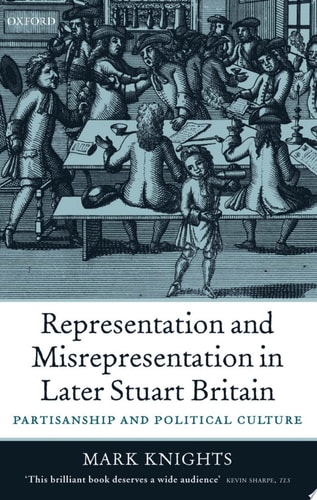
Representation and Misrepresentation in Later Stuart Britain: Partisanship and Political Culture
0
0
As an Amazon Associate and affiliate partner, Menrva Books earns from qualifying purchases. Learn more
Author Description
In this original and illuminating study, Mark Knights reveals how the political culture of the eighteenth century grew out of earlier trends and innovations. Arguing that the period 1675-1720 needs to be seen as the second stage of a seventeenth-century revolution that ran on until c.1720, the book traces the development of the public as an arbiter of politics, the growth of a national political culture, the shift towards a representative society, a crisis of public discourse and credibility, and a political enlightenment rooted in local and national partisan conflict. The 'public' acquired a new status in the later Stuart period as a result of frequent elections, the lapse of pre-publication licensing, the emergence of party politics, the creation of a public debt and ideological conflict over popular sovereignty. These factors enlarged the role of the public and required it to make frequent acts of judgement. Yet contemporaries from across the political spectrum feared that the public might be misled by the misrepresentations peddled by their rivals. Each side, and those ostensibly of no side, discerned a culture of passion, slander, libel, lies, hypocrisy, dissimulation, conspiracy, private languages and fictions. 'Truth' appeared an ambiguous, political matter. But the reaction to partisanship was also creative, for it helped to construct an ideal form of political discourse. This was one based on reason rather than passion, on politeness rather than incivility, on moderation rather than partisan zeal, on critical reading rather than credulity; and the realisation of those ideals rested on infrequent rather than frequent elections. Finding synergies between social, political, religious, scientific, literary, cultural and intellectual history, 'Representation and Misrepresentation' reinvigorates the debate about the emergence of 'the public sphere' in the later Stuart period.
Menrva's Summary
THE THESIS
This study investigates how the political culture of late seventeenth and early eighteenth-century Britain evolved through the emergence of a public sphere defined by partisan conflict and the struggle for credibility. Mark Knights, a professor of history, utilizes a wide array of contemporary pamphlets, political discourse, and institutional records to argue that the period between 1675 and 1720 represents a critical second phase of the seventeenth-century revolution. He posits that the tension between the necessity of public judgment and the fear of political misrepresentation fostered a new, albeit contested, form of political enlightenment.
THE SCOPE MAP
What You Will Find
- Analysis of the impact of frequent elections and the lapse of pre-publication licensing on political discourse.
- Examination of the ideological conflicts surrounding popular sovereignty and public debt.
- Exploration of the development of ideals such as reason, politeness, and moderation in response to partisan zeal.
Scope Limits
- The study focuses primarily on the period 1675-1720 and does not provide an exhaustive history of the entire Stuart dynasty.
- It does not attempt to provide a comprehensive biography of individual political figures, focusing instead on broader cultural and intellectual trends.
THE AUTHORITY PERSPECTIVE
Scholars recognize this work as a significant contribution to the study of the public sphere and the evolution of British political identity. Readers frequently note the academic density of the prose and the author's ability to synthesize social, religious, and intellectual history into a cohesive argument.
Page Count:
448
Publication Date:
2006-01-01
Publisher:
Oxford University Press
ISBN-10:
019151456X
ISBN-13:
9780191514562
History
British History
Stuart Period
English
English & College Success
Intellectual History
Community Tags
Similar Books