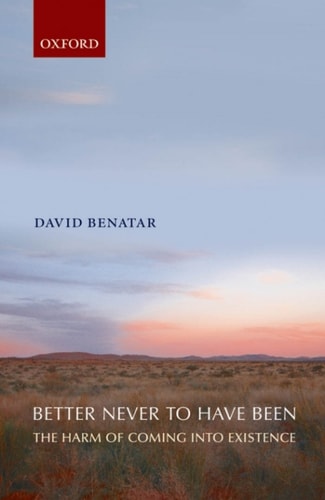
Better Never to Have Been: The Harm of Coming into Existence
0
0
As an Amazon Associate and affiliate partner, Menrva Books earns from qualifying purchases. Learn more
Author Description
Most people believe that they were either benefited or at least not harmed by being brought into existence. Thus, if they ever do reflect on whether they should bring others into existence---rather than having children without even thinking about whether they should---they presume that they do them no harm. Better Never to Have Been challenges these assumptions. David Benatar argues that coming into existence is always a serious harm. Although the good things in one's life make one's life go better than it otherwise would have gone, one could not have been deprived by their absence if one had not existed. Those who never exist cannot be deprived. However, by coming into existence one does suffer quite serious harms that could not have befallen one had one not come into existence. Drawing on the relevant psychological literature, the author shows that there are a number of well-documented features of human psychology that explain why people systematically overestimate the quality of their lives and why they are thus resistant to the suggestion that they were seriously harmed by being brought into existence. The author then argues for the 'anti-natal' view---that it is always wrong to have children---and he shows that combining the anti-natal view with common pro-choice views about foetal moral status yield a 'pro-death' view about abortion (at the earlier stages of gestation). Anti-natalism also implies that it would be better if humanity became extinct. Although counter-intuitive for many, that implication is defended, not least by showing that it solves many conundrums of moral theory about population.
Menrva's Summary
THE THESIS
The central question investigated is whether the act of bringing a new human being into existence is inherently harmful to that individual. David Benatar, a philosopher specializing in ethics, constructs a rigorous argument based on the asymmetry between pleasure and pain. He posits that while existence introduces both benefits and harms, the absence of existence avoids all harms, making non-existence a superior state. The author utilizes logical frameworks and psychological research to challenge the common assumption that life is always a net benefit.
THE SCOPE MAP
What You Will Find
- The Asymmetry Argument regarding the presence and absence of pleasure and pain
- Analysis of psychological biases that lead individuals to overestimate their quality of life
- Ethical implications of anti-natalism regarding reproduction and human extinction
- Philosophical exploration of population ethics and moral status
Scope Limits
- The text does not provide practical parenting advice or sociological studies on family structures
- It does not focus on theological or religious arguments against anti-natalism
THE AUTHORITY PERSPECTIVE
Experts and philosophers frequently cite this work as the foundational text for modern academic anti-natalism. Readers often note the high density of the logical prose, which requires careful attention to follow the author's specific philosophical deductions.
Page Count:
250
Publication Date:
2006-01-01
Publisher:
Oxford University Press
ISBN-10:
0191516317
ISBN-13:
9780191516313
Philosophy
Life
Ethics
Anti-natalism
Moral Philosophy
Community Tags
Similar Books