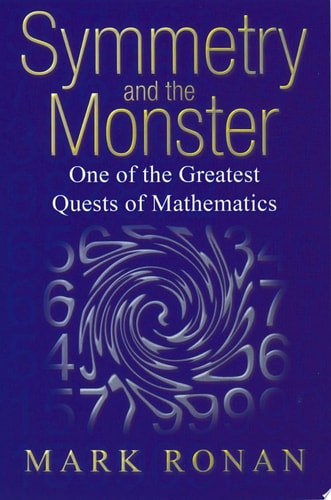
Symmetry and the Monster: One of the Greatest Quests of Mathematics
0
0
As an Amazon Associate and affiliate partner, Menrva Books earns from qualifying purchases. Learn more
Author Description
Mathematics is driven forward by the quest to solve a small number of major problems--the four most famous challenges being Fermat's Last Theorem, the Riemann Hypothesis, Poincaré's Conjecture, and the quest for the 'Monster' of Symmetry. Now, in an exciting, fast-paced historical narrative ranging across two centuries, Mark Ronan takes us on an exhilarating tour of this final mathematical quest. Ronan describes how the quest to understand symmetry really began with the tragic young genius Evariste Galois, who died at the age of 20 in a duel. Galois, who spent the night before he died frantically scribbling his unpublished discoveries, used symmetry to understand algebraic equations, and he discovered that there were building blocks or 'atoms of symmetry.' Most of these building blocks fit into a table, rather like the periodic table of elements, but mathematicians have found 26 exceptions. The biggest of these was dubbed 'the Monster'--a giant snowflake in 196,884 dimensions. Ronan, who personally knows the individuals now working on this problem, reveals how the Monster was only dimly seen at first. As more and more mathematicians became involved, the Monster became clearer, and it was found to be not monstrous but a beautiful form that pointed out deep connections between symmetry, string theory, and the very fabric and form of the universe.
Menrva's Summary
THE THESIS
This book investigates the two-century mathematical pursuit to classify the finite simple groups, culminating in the discovery and understanding of the 'Monster' group. Mark Ronan, a mathematician who participated in the collaborative effort to map these structures, utilizes historical biography and technical narrative to explain the evolution of group theory. He argues that the quest for the Monster is not merely an abstract exercise but a fundamental exploration of the symmetries that define the physical universe.
THE SCOPE MAP
What You Will Find
- Historical overview of group theory from Evariste Galois to the late 20th century
- Explanation of the 'atoms of symmetry' and the classification of finite simple groups
- Biographical sketches of key mathematicians involved in the project
- Conceptual links between group theory, string theory, and cosmology
Scope Limits
- Does not provide rigorous proofs or formal mathematical derivations for the classification theorem
- Does not cover the entirety of modern algebraic geometry outside the context of symmetry
THE AUTHORITY PERSPECTIVE
Experts and readers alike praise this work for its ability to translate highly abstract mathematical concepts into a readable historical narrative. The text is frequently cited as an accessible entry point for those interested in the human side of complex mathematical discovery.
Page Count:
276
Publication Date:
2006-01-01
Publisher:
Oxford University Press, Incorporated
ISBN-10:
0191517666
ISBN-13:
9780191517662
Biography
Popular Science
Symétrie
Histoire
Symmetrie
Mathematics - General
Mathematics Statistics
Monster-Gruppe
Mathematics
Group Theory
Snow crystals
Symmetry
Mathématiques
Science History
Groepentheorie
Symmetry Mathematics
Community Tags
Similar Books