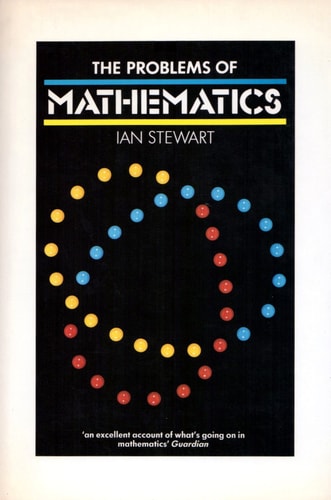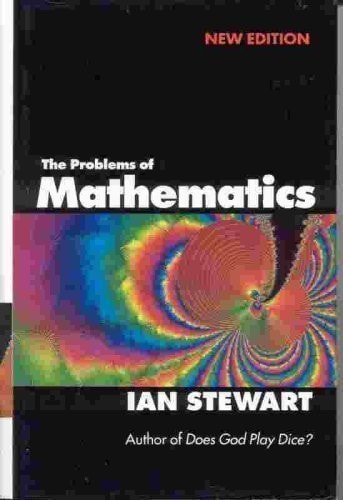
The Problems of Mathematics
0
0
As an Amazon Associate and affiliate partner, Menrva Books earns from qualifying purchases. Learn more
Author Description
Greeted with terrific reviews, the first edition of this book proved to be widely popular as both a teaching aid and an entertaining introduction to modern mathematics. It succeeded in opening the door for general readers to the power and beauty of a field often thought of as remote and lifeless. In fact, more mathematical research is being done today than ever before, while the field is evolving with unprecedented rapidity and excitement. For this second edition, Ian Stewart has fully revised the text to incorporate recent developments. There are many new illustrations, and three new chapters, including one on Kepler's sphere-packing problem, which has recently been solved, 380 years after it was first articulated. In addition, the book surveys many other areas of current research in nontechnical terms, describing what the key problems are, where they come from, how they get solved, and what can be done with the answers that are forthcoming. Readers will learn what mathematicians are like, and how their work has affected our society and history. Topics include such famous problems as Fermat's last theorem, the Riemann hypothesis, the Poincare conjecture, prime numbers, non-Euclidean geometry, the concept of infinity, probability, catastrophe theory, chaos, fractals, algorithms, and undecidable propositions. A final chapter discusses the relation between mathematics and its applications. Each topic is developed within a historical framework, and a number of recent breakthroughs are presented for the first time in a manner that general readers will find easy to understand. Ideal as supplementary reading in the classroom, The Problems of Mathematics will also be enjoyed by anyone interested in mathematics or who has sought to understand the fascinating work taking place in the field today.
Menrva's Summary
THE THESIS
How do contemporary mathematical problems shape our understanding of the universe and the evolution of the field itself? Ian Stewart, a prominent mathematician and author, utilizes his extensive academic background to demystify complex mathematical concepts for the general reader. By framing modern research within its historical context, he argues that mathematics is a dynamic, rapidly evolving discipline rather than a static collection of abstract rules. The text serves as an accessible bridge between professional research and public interest, illustrating the practical and theoretical implications of ongoing mathematical inquiry.
THE SCOPE MAP
What You Will Find
- Historical analysis of major mathematical breakthroughs including Fermat's Last Theorem and the Poincare conjecture.
- Explanations of modern concepts such as chaos theory, fractals, and catastrophe theory.
- Discussion of the relationship between pure mathematics and real-world applications.
- Case studies on specific problems like Kepler's sphere-packing.
Scope Limits
- The text does not provide rigorous proofs or advanced technical derivations for the problems discussed.
- It does not serve as a comprehensive textbook for undergraduate-level mathematics curricula.
THE AUTHORITY PERSPECTIVE
Experts and educators frequently cite this work as a highly effective introductory text for non-specialists interested in the state of modern mathematics. Readers often note that Stewart successfully balances historical narrative with technical clarity, making it a standard recommendation for those seeking to understand the significance of current mathematical research.
Page Count:
368
Publication Date:
1992-10-01
Publisher:
Oxford University Press
ISBN-10:
0192861484
ISBN-13:
9780192861481
Science
Non-Fiction
Popular Science
Mathematics
Popular Works
Science History