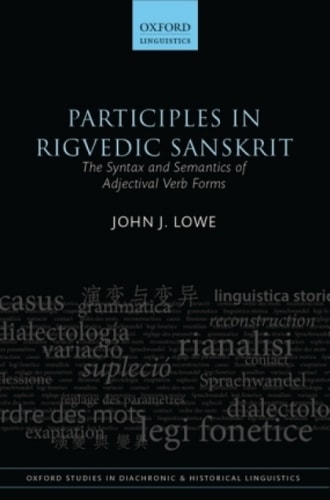
Participles in Rigvedic Sanskrit: The Syntax and Semantics of Adjectival Verb Forms
0
0
As an Amazon Associate and affiliate partner, Menrva Books earns from qualifying purchases. Learn more
Author Description
This book examines several thousand examples of tense-aspect stem participles in the Rigveda, and the passages in which they appear, in terms of both their syntax and semantics. The Rigveda is an ancient collection of sacred Indian hymns, written in Vedic Sanskrit, and is one of the oldest extant texts in any Indo-European language. It is also a poetic text in which deliberate obscurity is the governing aesthetic and in which the rules of language are pushed to their limits in order to produce the ideal poetic expression. Many Vedic sentences are of controversial, disputed meaning, and Vedic scholarship is thus fraught with controversy. John J. Lowe applies formal linguistic analysis to the data and produces a comprehensive formal model of how participles are used. The author uses his findings to recategorize the data, by defining certain stems and stem-types as outside the synchronic category of participle on the basis of their syntactic and semantic properties. He suggests alternative sources for these forms and considers the linguistic processes that transformed old participles into non-participial entities. In his conclusion he reassesses the category of participles within the verbal and nominal systems, looks at their prehistory in Proto-Indo-European, and describes their universal, typological characteristics. Among his conclusions are that tense-aspect-stem participles have the technical properties of adjectival verbs, not verbal adjectives, and that such participles are not fully dependent on corresponding finite verbal forms. That is, a perfect participle, for example, need not share all the semantic and functional features of the finite perfect forms built to the same stem. These and many other conclusions drawn either directly challenge or radically revise received opinion and recent work.
Menrva's Summary
THE THESIS
This book investigates the syntactic and semantic functions of tense-aspect stem participles within the Rigveda to determine their classification as adjectival verbs. John J. Lowe, a specialist in historical linguistics, utilizes formal linguistic analysis to examine thousands of examples from this ancient collection of sacred hymns. By applying rigorous structural models to these archaic texts, the author challenges established scholarly interpretations regarding the nature of Vedic verbal forms and their development from Proto-Indo-European roots.
THE SCOPE MAP
What You Will Find
- A comprehensive analysis of tense-aspect stem participles in the Rigveda.
- A formal linguistic model for categorizing Vedic verbal and nominal systems.
- Diachronic investigation into the prehistory of these forms in Proto-Indo-European.
Scope Limits
- The study focuses primarily on the Rigveda and does not provide a general grammar of Vedic Sanskrit.
- The analysis is restricted to the specific syntactic and semantic properties of participles rather than broader poetic or theological interpretations.
THE AUTHORITY PERSPECTIVE
Scholars in the field of Indo-European linguistics recognize this work as a rigorous application of formal syntax to one of the most challenging corpora in historical philology. Readers frequently note the high level of technical density, making it a specialized resource for advanced students and researchers of Vedic language and diachronic linguistics.
Page Count:
464
Publication Date:
2015-01-01
Publisher:
OUP Oxford
ISBN-10:
0191005053
ISBN-13:
9780191005053
English
Historical linguistics
Academic
English & College Success
Philology
Linguistics
Vedic Language
Sanskrit
Community Tags
Similar Books