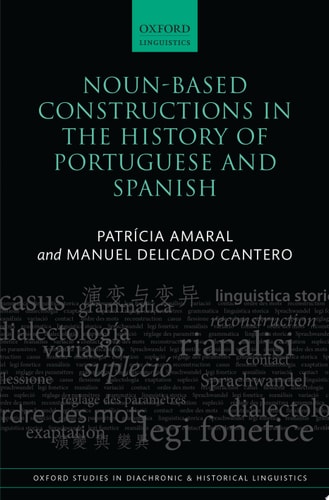
Noun-Based Constructions in the History of Portuguese and Spanish
Author Description
This book explores syntactic and semantic change in three types of construction in Spanish and Portuguese: (i) complex determiner phrases with clausal adjunction (el hecho de, o facto de), (ii) complex prepositions/complementizers and complex connectives (sin embargo de/sem embargo de, so(b) pena de), and (iii) complex predicates containing light verbs (dar consejo/conselho de). While these constructions are syntactically different, they are all clause-taking complex expressions containing a noun followed by the functional preposition de ('of'). This book is the first work to use a systematic comparative corpus study to explore these expressions together; this approach allows individual changes to be distinguished from general changes, as well as emphasizing the chronological clustering of changes that involve complex constructions in both languages. By studying mechanisms of language change and their outcomes in two sister languages, Patrícia Amaral and Manuel Delicado Cantero address questions such as: How do complex constructions evolve? How does the meaning of the noun change when considered in isolation and when compared to the meaning of the whole construction? And how do syntactic categories change over time? This study of two closely-related languages reveals distinct developments occurring in parallel, and provides a crucial test case for theories of language change.
Menrva's Summary
THE THESIS
This book investigates the syntactic and semantic evolution of noun-based complex constructions in Spanish and Portuguese to determine how these expressions change over time. Authors Manuel Delicado Cantero and Patrícia Amaral utilize a comparative corpus-based methodology to analyze how clause-taking expressions containing the preposition 'de' develop within these two sister languages. By examining these structures, the authors provide a framework for understanding the mechanisms of grammaticalization and the chronological clustering of linguistic shifts.
THE SCOPE MAP
What You Will Find
- Comparative analysis of complex determiner phrases, complex prepositions, and complex predicates
- Systematic corpus study of Spanish and Portuguese historical data
- Theoretical discussion on syntactic category change and semantic bleaching
Scope Limits
- The study is restricted to constructions containing a noun followed by the preposition 'de'
- The analysis does not cover non-Romance language comparisons or modern dialectal variations outside the historical scope
THE AUTHORITY PERSPECTIVE
Experts recognize this work as a significant contribution to the field of diachronic linguistics due to its rigorous comparative methodology. Scholars frequently note the academic density of the prose, making it a specialized resource for researchers focusing on Romance language evolution.
Page Count:
200
Publication Date:
2022-01-01
Publisher:
OUP Oxford
ISBN-10:
0192586459
ISBN-13:
9780192586452
Syntax
Linguistics
Historical linguistics
English
Semantics
Academic
English & College Success
Community Tags
Similar Books