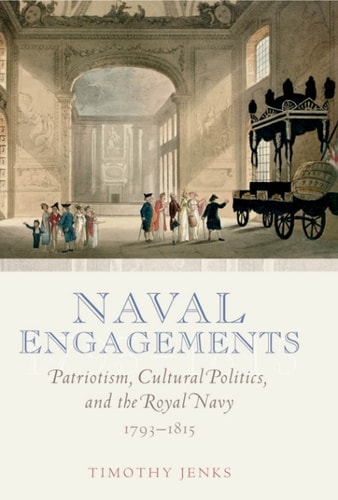
Naval Engagements: Patriotism, Cultural Politics, and the Royal Navy 1793-1815
0
0
As an Amazon Associate and affiliate partner, Menrva Books earns from qualifying purchases. Learn more
Author Description
The construction of an important element in British national identity is explored in Naval Engagements, looking at the ways in which the navy - a major symbol of national community - was given meaning by a range of social groupings. The study is at once a cultural history of national identity, a social history of naval commemoration, and a political history of struggles over patriotism. Examining the place that naval symbols occupied in British wartime political culture, Timothy Jenks argues that these were more relevant to patriotic discourse than the more commonly explored 'apotheosis' of the Hanoverian monarchs. He establishes the centrality of public images of admirals to the 'victory culture' and political experience of the day, tracing efforts by groups across the political spectrum to invest these figures with appropriate political capital and contemporary meaning. He engages with arguments concerning popular patriotism and the relative cohesiveness of British society. Most importantly, the book establishes the centrality of naval symbolism to the political culture of Georgian Britain. At the same time, it reveals the social practices and discourses that consistently interacted to delimit and restrain a variety of projects ostensibly designed to foster patriotism and national identity. Patriotism was contested, this study argues, rather than consensual, and British national identity in the period was contingent, an ambivalence crucial to the manner in which naval symbols functioned.
Menrva's Summary
THE THESIS
This study investigates how the Royal Navy functioned as a central, contested symbol of British national identity and political discourse during the French Revolutionary and Napoleonic Wars. Timothy Jenks, a historian specializing in British cultural and political history, utilizes a wide array of primary sources, including public prints, commemorative materials, and political pamphlets. He argues that naval symbols, particularly the public images of admirals, were more significant to the formation of wartime patriotic culture than the traditional focus on the monarchy. By examining these symbols, Jenks demonstrates that patriotism in Georgian Britain was not a unified consensus but a site of active political struggle and social negotiation.
THE SCOPE MAP
What You Will Find
- Analysis of naval commemoration and the construction of 'victory culture' between 1793 and 1815.
- Examination of how diverse social groups utilized naval imagery to advance specific political agendas.
- Investigation into the role of public prints and visual culture in shaping national identity.
Scope Limits
- The study does not provide a comprehensive military or tactical history of naval engagements during the period.
- It focuses primarily on the domestic political and cultural reception of the navy rather than the internal administrative or operational mechanics of the Admiralty.
THE AUTHORITY PERSPECTIVE
Historians and scholars of the Georgian period frequently cite this work for its nuanced approach to the intersection of political culture and national identity. Readers often note the academic density of the prose, which provides a rigorous examination of how symbolic capital was contested in the public sphere.
Page Count:
352
Publication Date:
2006-01-01
Publisher:
Oxford University Press
ISBN-10:
0191516414
ISBN-13:
9780191516412
History
Cultural History
National Identity
Political History
Naval history
European History
Great Britain
British History
Community Tags
Similar Books