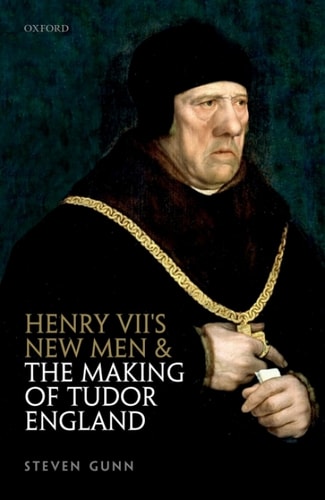
Henry VII's New Men and the Making of Tudor England
0
0
As an Amazon Associate and affiliate partner, Menrva Books earns from qualifying purchases. Learn more
Author Description
The reign of Henry VII is important but mysterious. He ended the Wars of the Roses and laid the foundations for the strong governments of Henry VIII and Elizabeth I. Yet his style of rule was unconventional and at times oppressive. At the heart of his regime stood his new men, low-born ministers with legal, financial, political, and military skills who enforced the king's will and in the process built their own careers and their families' fortunes. Some are well known, like Sir Edward Poynings, governor of Ireland, or Empson and Dudley, executed to buy popularity for the young Henry VIII. Others are less famous. Sir Robert Southwell was the king's chief auditor, Sir Andrew Windsor the keeper of the king's wardrobe, Sir Thomas Lovell, the Chancellor of the Exchequer so trusted by Henry that he was allowed to employ the former Yorkist pretender Lambert Simnel as his household falconer. Some paved the way to glory for their relatives. Sir Thomas Brandon, master of the horse, was the uncle of Henry VIII's favourite Charles Brandon, duke of Suffolk. Sir Henry Wyatt, keeper of the jewel house, was father to the poet Sir Thomas Wyatt. This volume, based on extensive archival research, presents a kaleidoscopic portrait of the new men. It analyses the offices and relationships through which they exercised power and the ways they gained their wealth and spent it to sustain their new-found status. It establishes their importance in the operation of Henry's government and, as their careers continued under his son, in the making of Tudor England.
Menrva's Summary
THE THESIS
This work investigates how a specific group of low-born ministers, known as Henry VII's 'new men,' functioned as the primary instruments of royal authority and architects of the early Tudor state. Professor Steven Gunn utilizes extensive archival research to examine the professional trajectories, financial activities, and political influence of these figures. By analyzing their roles in legal, financial, and military administration, the author argues that these individuals were essential to the transition from the instability of the Wars of the Roses to the centralized governance of the later Tudor period.
THE SCOPE MAP
What You Will Find
- Analysis of administrative offices including the Exchequer, the Wardrobe, and the Jewel House.
- Biographies of key figures such as Sir Thomas Lovell, Sir Henry Wyatt, and Empson and Dudley.
- Examination of social mobility and the accumulation of wealth among the king's servants.
- Discussion of the continuity of administrative power from the reign of Henry VII into the reign of Henry VIII.
Scope Limits
- The text focuses primarily on the administrative and political functions of these men rather than a comprehensive biography of Henry VII himself.
- It does not provide a general history of the Wars of the Roses, assuming prior knowledge of the period's political context.
THE AUTHORITY PERSPECTIVE
Historians recognize this volume as a significant contribution to the study of early Tudor administration and social mobility. Readers frequently note the academic density of the prose and the meticulous use of primary source evidence to reconstruct the lives of these lesser-known political actors.
Page Count:
352
Publication Date:
2016-01-01
Publisher:
OUP Oxford
ISBN-10:
0191634883
ISBN-13:
9780191634888
Biography
History
History - Modern
British History
Great Britain
Tudor England
Political History
European History
Community Tags
Similar Books