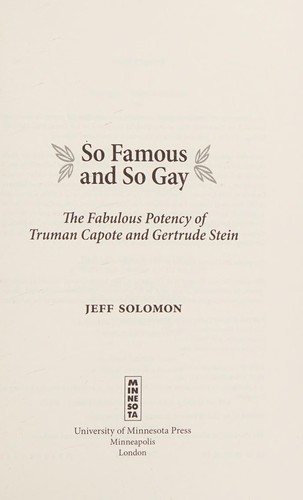
So Famous and So Gay
0
0
As an Amazon Associate and affiliate partner, Menrva Books earns from qualifying purchases. Learn more
Author Description
Gertrude Stein (1874-1946) and Truman Capote (1924-1984) should not have been famous. They made their names between the Oscar Wilde trial and Stonewall, when homosexuality meant criminality and perversion. And yet both Stein and Capote, openly and exclusively gay, built their outsize reputations on works that directly featured homosexuality and a queer aesthetic. How did these writers become mass-market celebrities while other gay public figures were closeted or censored? And what did their fame mean for queer writers and readers, and for the culture in general? Jeff Solomon explores these questions in So Famous and So Gay. Celebrating lesbian partnership, The Autobiography of Alice B. Toklas was published in 1933 and rocketed Stein, the Jewish lesbian intellectual avant-garde American expatriate, to international stardom and a mass-market readership. Fifteen years later, when Capote published Other Voices, Other Rooms, a novel of explicit homosexual sex and love, his fame itself became famous. Through original archival research, Solomon traces the construction and impact of the writers' public personae from a gay-affirmative perspective. He historically situates author photos, celebrity gossip, and other ephemera to explain how Stein and Capote expressed homosexuality and negotiated homophobia through the fleeting depiction of what could not be directly written--maneuvers that other gay writers such as Gore Vidal, Tennessee Williams, and James Baldwin could not manage at the time. Finally So Famous and So Gay reveals what Capote's and Stein's debuts, Other Voices, Other Rooms and Three Lives, held for queer readers in terms of gay identity and psychology--and for gay authors who wrote in their wake
Menrva's Summary
THE THESIS
This book investigates how two openly gay writers, Gertrude Stein and Truman Capote, achieved mass-market celebrity in eras when homosexuality was criminalized and pathologized. Jeff Solomon examines the historical context between the Oscar Wilde trials and the Stonewall Uprising, exploring how Stein and Capote navigated homophobia and expressed their identities through their work and public personas. The book analyzes the construction and impact of their fame, contrasting their experiences with other gay figures who remained closeted or faced censorship. Through archival research, it reveals how their literary debuts offered queer readers insights into gay identity and psychology, influencing subsequent generations of gay authors.
THE SCOPE MAP
- Analysis of Gertrude Stein's rise to international stardom with 'The Autobiography of Alice B. Toklas'.
- Examination of Truman Capote's fame following the publication of 'Other Voices, Other Rooms'.
- Exploration of how Stein and Capote expressed homosexuality and negotiated homophobia in their public lives and works.
- Historical situating of author photos, celebrity gossip, and other ephemera.
- Comparison of Stein and Capote's public careers with those of other gay writers like Gore Vidal, Tennessee Williams, and James Baldwin.
- Discussion of the impact of their work on queer readers' identity and psychology.
- Focus on a gay-affirmative perspective in tracing the construction and impact of their public personae.
- Original archival research utilized to support the historical analysis.
THE AUTHORITY PERSPECTIVE
The book is an academic study that delves into the complex relationship between queer identity, fame, and cultural acceptance in the mid-20th century United States. It offers a detailed analysis of how Gertrude Stein and Truman Capote, despite societal pressures, leveraged their openly gay identities to achieve significant public recognition. The work is noted for its use of original archival research and its gay-affirmative perspective in re-examining the construction and impact of these authors' public personas. It provides valuable insights into the historical negotiation of homophobia within the literary and cultural spheres.
Page Count:
276
Publication Date:
2017-01-01
ISBN-10:
0816696799
ISBN-13:
9780816696796
Science
History
Biography
Non-Fiction
American
Cultural History
Queer Studies
Literary Criticism
Community Tags
Similar Books