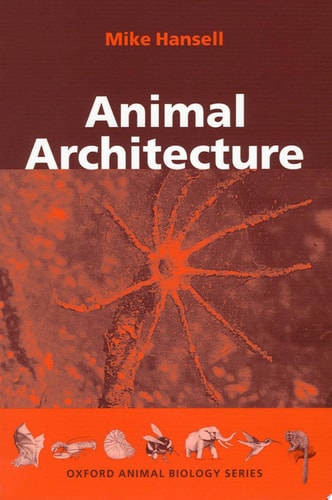
Animal Architecture
0
0
As an Amazon Associate and affiliate partner, Menrva Books earns from qualifying purchases. Learn more
Author Description
Construction behaviour occurs across the entire spectrum of the animal kingdom and affects the survival of both builders and other organisms associated with them. Animal Architecture provides a comprehensive overview of the biology of animal building. The book recognizes three broad categories of built structure: homes, traps, and courtship displays. Even though some of these structures are complex and very large, the behaviour required to build them is generally simple and the anatomy for building unspecialized. Standardization of building materials helps to keep building repertoires simple, while self-organizing effects help create complexity. In a case-study approach to function, insects demonstrate how homes can remain operational while they grow, spiderwebs illustrate mechanical design, and the displays of bowerbirds raise the possibility of persuasion through design rather than just decoration. Studies of the costs to builders provide evidence of optimal designs and of trade-offs with other life history traits. As ecosystem engineers, the influence of builders is extensive and their effect is generally to enhance biodiversity through niche construction. Animal builders can therefore represent model species for the study of the emerging subject of environmental inheritance. Building, and in particular building with silk, has been demonstrated to have important evolutionary consequences. This book is intended for students and researchers in comparative animal biology, but will also be of relevance and use to the increasing numbers of architects and civil engineers interested in developing ideas from the animal kingdom.
Menrva's Summary
THE THESIS
This book investigates the biological mechanisms, evolutionary significance, and ecological impact of construction behavior across the animal kingdom. Mike Hansell, a specialist in animal behavior, synthesizes research on how animals build structures ranging from homes to traps and courtship displays. He argues that complex structures often arise from simple behavioral repertoires and self-organizing processes, positioning animal builders as key subjects for understanding environmental inheritance and niche construction.
THE SCOPE MAP
What You Will Find
- Analysis of three primary categories of animal structures: homes, traps, and courtship displays.
- Examination of the relationship between building materials, behavioral simplicity, and structural complexity.
- Case studies on insects, spiders, and bowerbirds to illustrate mechanical design and evolutionary trade-offs.
Scope Limits
- The text does not provide a comprehensive catalog of every known animal builder.
- It does not focus on the architectural engineering of human-made structures beyond theoretical inspiration.
THE AUTHORITY PERSPECTIVE
Experts recognize this work as a foundational text for understanding the intersection of ethology and structural biology. Readers frequently note the academic density of the prose, making it most suitable for students and researchers in the biological sciences.
Page Count:
334
Publication Date:
2005-01-01
Publisher:
Oxford University Press
ISBN-10:
0191523178
ISBN-13:
9780191523175
Architecture
Biology
Zoology
Evolutionary Biology
Ecology
Nature
Community Tags
Similar Books



![Instructor's resource manual to accompany Biology, 3nd edition [by] Karen Arms, Pamela S. Camp](https://storage.googleapis.com/menrva_img_storage/covers/generated/9780030036477.jpg)