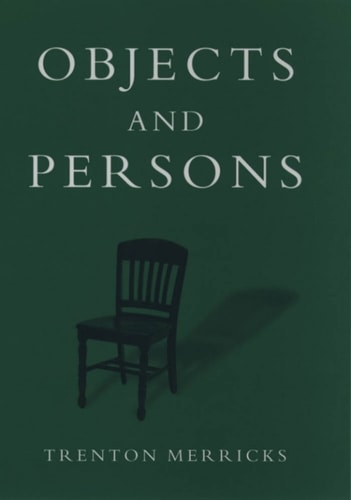
Objects and Persons
0
0
As an Amazon Associate and affiliate partner, Menrva Books earns from qualifying purchases. Learn more
Author Description
There are no statues. Or rocks. Or chairs. Or stars. But there are microscopic objects arranged statuewise and rockwise and chairwise and starwise. Moreover, there are--in addition to microscopic objects arranged humanwise--composite human beings. Or so Trenton Merricks argues. The ontology of Objects and Persons is motivated, in large part, by causal considerations. One of the central ideas is that physical objects are causally non-redundant: physical objects cause things that are not wholly overdetermined by their proper parts. Merricks 'eliminates' statues and other inanimate composite macrophysical objects on the grounds that they would--if they existed--be at best completely causally redundant. Merricks defends our existence by arguing, from certain facts about mental causation, that we human beings cause things that are not overdetermined by our proper parts. A second strand of argument for Merricks's overall ontology involves a variety of philosophical puzzles, puzzles that are dealt with in illuminating and often novel ways. Many other issues are addressed along the way, including free will, the 'reduction' of a composite object to its parts, and the ways in which identity over time can "for practical purposes" be a matter of convention. Anyone working in metaphysics will enjoy this lucid and provocative book.
Menrva's Summary
THE THESIS
Trenton Merricks investigates the ontological status of composite objects, specifically questioning whether inanimate macrophysical objects exist or if they are merely arrangements of microscopic parts. Merricks, a professional philosopher, utilizes causal arguments to propose that while inanimate composite objects are causally redundant and thus non-existent, human beings maintain a unique status due to their role in mental causation. The text constructs a framework where physical objects must be causally non-redundant to be considered real, applying this logic to resolve long-standing puzzles in metaphysics.
THE SCOPE MAP
What You Will Find
- Arguments regarding the causal redundancy of inanimate composite objects
- Analysis of mental causation and human existence
- Philosophical resolutions to puzzles concerning identity over time
- Discussions on free will and the reduction of composite objects
Scope Limits
- The text does not provide a comprehensive history of mereology
- It does not address empirical scientific evidence beyond the philosophical implications of physical composition
THE AUTHORITY PERSPECTIVE
Experts in metaphysics frequently cite this work as a significant contribution to the debate on mereological nihilism and the nature of composition. Readers often note the high density of the prose, which requires a strong background in analytic philosophy to fully grasp the logical arguments presented.
Page Count:
216
Publication Date:
2001-01-01
Publisher:
Oxford University Press
ISBN-10:
0191529680
ISBN-13:
9780191529689
Philosophy
Philosophy of
Academic
Metaphysics
Whole And Parts philosophy
Ontology
Causation