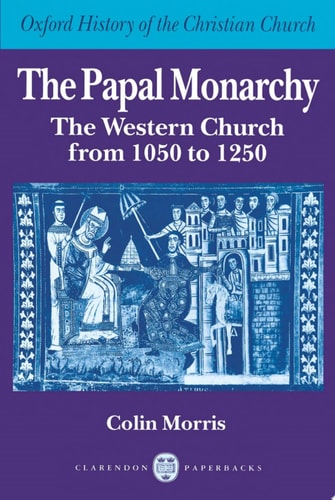
The Papal Monarchy: The Western Church from 1050 to 1250
0
0
As an Amazon Associate and affiliate partner, Menrva Books earns from qualifying purchases. Learn more
Author Description
The two centuries covered in this volume were among the most creative in the history of the Church. Colin Morris charts the emergence of much that is considered characteristic of European culture and religion, including universities and commercial cities, the crusades, the friars, chivalry, marriage, and church architecture. In all these developments, the Roman Church played an important and often fundamental role. A re-evaluation of that role is now particularly apt given the dissolution of Christendom in its old form witnessed by today's generation.
Menrva's Summary
THE THESIS
This volume investigates how the Roman Church functioned as a central, transformative institution in Western Europe during the period of 1050 to 1250. Colin Morris, a respected historian of the medieval Church, examines the intersection of ecclesiastical authority with the rapid social and cultural shifts of the High Middle Ages. He argues that the Church was not merely a religious entity but a primary architect of the era's emerging structures, including urban commercial growth, educational systems, and evolving social codes like chivalry.
THE SCOPE MAP
What You Will Find
- Analysis of the Gregorian Reform and the subsequent consolidation of papal power.
- Examination of the rise of universities and the intellectual influence of the clergy.
- Discussion of the Crusades and their impact on Western religious identity.
- Exploration of the development of canon law and its influence on marriage and social norms.
- Overview of the emergence of the friars and new monastic movements.
Scope Limits
- The text focuses primarily on the institutional and social history of the Western Church rather than detailed theological treatises.
- It does not provide an exhaustive history of the Eastern Orthodox Church during this period.
THE AUTHORITY PERSPECTIVE
Scholars and historians frequently cite this work as a standard, authoritative text for understanding the institutional evolution of the medieval Church. Readers often note the academic density of the prose, which provides a comprehensive and well-researched overview of the period's complex administrative and social developments.
Page Count:
696
Publication Date:
1989-01-01
Publisher:
Oxford University Press
ISBN-10:
0191520535
ISBN-13:
9780191520532
History
Religion
European History
Papacy history
Church History
Christian sociology
Papacy
Community Tags
Similar Books