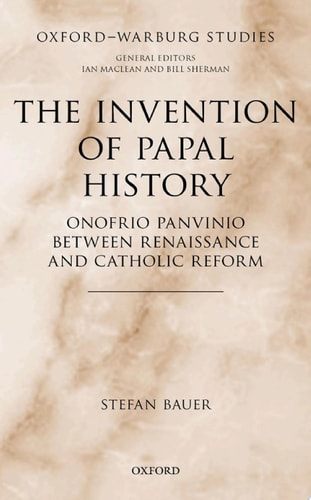
The Invention of Papal History: Onofrio Panvinio between Renaissance and Catholic Reform
0
0
As an Amazon Associate and affiliate partner, Menrva Books earns from qualifying purchases. Learn more
Author Description
How was the history of post-classical Rome and of the Church written in the Catholic Reformation? Historical texts composed in Rome at this time have been considered secondary to the city's significance for the history of art. The Invention of Papal History corrects this distorting emphasis and shows how historical writing became part of a comprehensive formation of the image and self-perception of the papacy. By presenting and fully contextualising the path-breaking works of the Augustinian historian Onofrio Panvinio (1530-1568), Stefan Bauer shows what type of historical research was possible in the late Renaissance and the Catholic Reformation. Crucial questions were, for example: How were the pontiffs elected? How many popes had been puppets of emperors? Could any of the past machinations, schisms, and disorder in the history of the Church be admitted to the reading public? Historiography in this period by no means consisted entirely of commissioned works written for patrons; rather, a creative interplay existed between, on the one hand, the endeavours of authors to explore the past and, on the other hand, the constraints of ideology and censorship placed on them. The Invention of Papal History sheds new light on the changing priorities, mentalities, and cultural standards that flourished in the transition from the Renaissance to the Catholic Reformation.
Menrva's Summary
THE THESIS
This work investigates how the historical writing of the Catholic Reformation shaped the institutional identity and self-perception of the papacy. Stefan Bauer, a scholar of early modern intellectual history, utilizes the life and scholarly output of the Augustinian historian Onofrio Panvinio to analyze the intersection of academic research and ecclesiastical censorship. The book argues that historical inquiry during this period was not merely a product of patronage, but a complex negotiation between the desire for empirical truth and the ideological constraints of the era.
THE SCOPE MAP
What You Will Find
- An analysis of 16th-century Roman historiography and the transition from Renaissance to Catholic Reform.
- A detailed examination of Onofrio Panvinio’s research methodologies and major historical texts.
- A study of the institutional pressures, including censorship and ideological mandates, that influenced historical narratives.
Scope Limits
- The text focuses primarily on the Roman context and the specific contributions of Panvinio rather than a comprehensive history of all European ecclesiastical historiography.
THE AUTHORITY PERSPECTIVE
Scholars recognize this work as a significant contribution to the understanding of early modern intellectual history and the development of historical methodology. Readers frequently note the academic density of the prose and the meticulous archival research that underpins Bauer's analysis.
Page Count:
274
Publication Date:
2019-01-01
Publisher:
OUP Oxford
ISBN-10:
0192533673
ISBN-13:
9780192533678
History
Biography
Europe
Church History
Renaissance
Catholic Reformation
Counter-Reformation
Papacy
Historiography
European History
Community Tags
Other Editions(3)
Similar Books