Simple Models of Magnetism
0
0
As an Amazon Associate and affiliate partner, Menrva Books earns from qualifying purchases. Learn more
Author Description
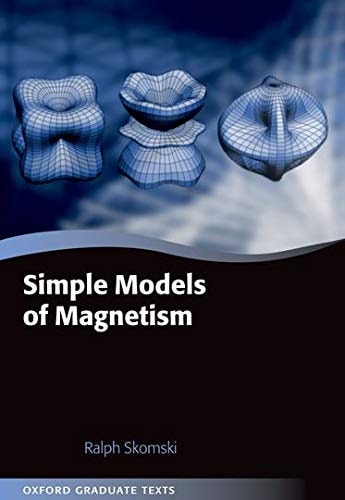
For hundreds of years, models of magnetism have been pivotal in the understanding and advancement of science and technology, from the Earth's interpretation as a magnetic dipole to quantum mechanics, statistical physics, and modern nanotechnology. This book is the first to envision the field of magnetism in its entirety. It complements a rich literature on specific models of magnetism and provides an introduction to simple models, including some simple limits of complicated models. The book is written in an easily accessible style, with a limited amount of mathematics, and covers a wide range of quantum-mechanical, finite-temperature, micromagnetic and dynamical models. It deals not only with basic magnetic quantities, such as moment, Curie temperature, anisotropy, and coercivity, but also with modern areas such as nanomagnetism and spintronics, and with 'exotic' themes, as exemplified by the polymer analogy of magnetic phase transitions. Throughout the book, a sharp line is drawn between simple and simplistic models, and much space is devoted to discuss the merits and failures of the individual model approaches.
Menrva's Summary
THE THESIS
This book investigates the utility and limitations of simplified models in understanding the complex physical phenomena of magnetism across various scales. Ralph Skomski, a researcher in magnetic materials, provides a comprehensive framework that bridges classical magnetic theory with modern applications like spintronics and nanotechnology. By evaluating the merits and failures of specific model approaches, the text serves as a guide for distinguishing between useful simplifications and overly reductive interpretations in physical science.
THE SCOPE MAP
What You Will Find
- Coverage of quantum-mechanical, finite-temperature, micromagnetic, and dynamical models.
- Analysis of fundamental magnetic quantities including moment, Curie temperature, anisotropy, and coercivity.
- Exploration of modern topics such as nanomagnetism, spintronics, and polymer analogies for phase transitions.
Scope Limits
- The text does not provide an exhaustive derivation of every complex mathematical proof associated with advanced magnetism.
- It focuses primarily on conceptual models rather than serving as a comprehensive handbook for experimental laboratory procedures.
THE AUTHORITY PERSPECTIVE
Experts recognize this text as a valuable synthesis for graduate students and researchers seeking to understand the conceptual foundations of magnetic modeling. Readers frequently note that the prose remains accessible despite the technical subject matter, successfully balancing theoretical depth with practical clarity.
Page Count:
368
Publication Date:
2008-01-01
Publisher:
OUP Oxford
ISBN-10:
0191524751
ISBN-13:
9780191524752
Science
Magnetism
Statistical physics
Physics
Nanotechnology
Earth Sciences