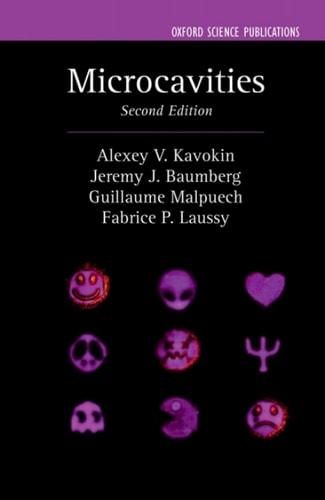
Microcavities
0
0
As an Amazon Associate and affiliate partner, Menrva Books earns from qualifying purchases. Learn more
Author Description
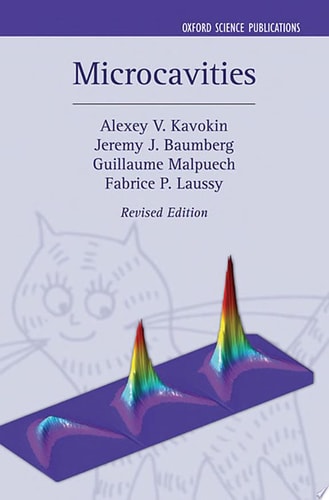
Microcavities are semiconductor, metal, or dielectric structures providing optical confinement in one, two or three dimensions. At the end of the 20th century, microcavities have attracted attention due to the discovery of a strong exciton-light coupling regime allowing for the formation of superposition light-matter quasiparticles: exciton-polaritons. In the following century several remarkable effects have been discovered in microcavities, including the Bose-Einstein condensation of exciton-polaritons, polariton lasing, superfluidity, optical spin Hall and spin Meissner effects, amongst other discoveries. Currently, polariton devices exploiting the bosonic stimulation effects at room temperature are being developed by laboratories across the world. This book addresses the physics of microcavities: from classical to quantum optics, from a Boltzmann gas to a superfluid. It provides the theoretical background needed for understanding the complex phenomena in coupled light-matter systems, and it presents a broad overview of experimental progress in the physics of microcavities.
Menrva's Summary
THE THESIS
This text investigates the fundamental physics and emergent phenomena of light-matter coupling within semiconductor, metal, and dielectric microcavities. The authors, all established researchers in the field of polaritonics, synthesize theoretical frameworks with experimental observations to explain how these structures facilitate the formation of exciton-polaritons and their subsequent quantum behaviors.
THE SCOPE MAP
What You Will Find
- Theoretical foundations of classical and quantum optics in confined structures
- Analysis of exciton-light coupling regimes
- Discussion of Bose-Einstein condensation and polariton lasing
- Overview of superfluidity and spin-related optical effects
- Experimental progress in room-temperature polariton device development
Scope Limits
- Does not cover general semiconductor manufacturing processes
- Excludes non-optical applications of microcavities
THE AUTHORITY PERSPECTIVE
Experts recognize this volume as a comprehensive reference for researchers and graduate students specializing in condensed matter physics and photonics. Readers frequently note the high level of technical rigor and the density of the mathematical derivations provided throughout the text.
Page Count:
608
Publication Date:
2017-01-01
Publisher:
OUP Oxford
ISBN-10:
0191085863
ISBN-13:
9780191085864
Science
Nanotechnology
Earth Sciences
Professional Career & Trade
Physics
Quantum optics
Community Tags
Other Editions(4)

Similar Books