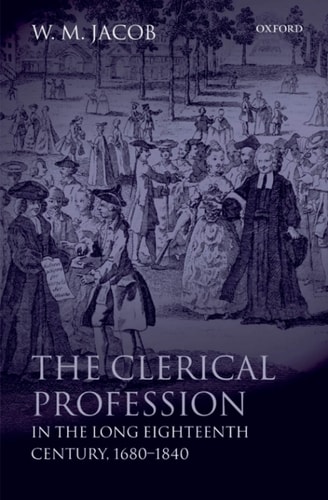
The Clerical Profession in the Long Eighteenth Century, 1680-1840
0
0
As an Amazon Associate and affiliate partner, Menrva Books earns from qualifying purchases. Learn more
Author Description
W. M. Jacob examines the concept of 'profession' during the later Stuart and Georgian period, with special reference to the clergy of the Church of England. He describes their social backgrounds, how they were recruited, selected, and educated, and obtained jobs; how they were paid, and their lifestyles and family life, as well as examining the evidence for what they did as leaders of worship, pastors and teachers, how their parishioners responded to them, and how they were supervised. Jacob concludes that, contrary to popular views, the clerical profession was much better organized, educated, and supervised than the medical and legal professions during this period. During the 'age of reform' from the 1780s to the 1830s, all the professions were criticized: Jacob suggests that the modest regulation and professional training introduced in the other learned professions in the 1830s only slowly brought them to the standard already achieved by the clerical profession.
Menrva's Summary
THE THESIS
This book investigates the structural development and professional standards of the Church of England clergy between 1680 and 1840. W. M. Jacob utilizes extensive historical records to challenge the prevailing narrative that the clerical profession was disorganized or poorly trained during the Stuart and Georgian eras. By analyzing recruitment, education, and pastoral duties, the author argues that the clergy maintained a higher degree of internal regulation and professional consistency than their legal and medical counterparts.
THE SCOPE MAP
What You Will Find
- Analysis of clerical social backgrounds and recruitment processes.
- Examination of educational requirements and job acquisition methods.
- Assessment of pastoral duties, including worship leadership and teaching.
- Comparative study of professional standards across the clergy, law, and medicine.
Scope Limits
- The study focuses primarily on the Church of England and does not provide an exhaustive analysis of non-conformist or dissenting religious groups.
- The research is confined to the period between 1680 and 1840, excluding later Victorian ecclesiastical developments.
THE AUTHORITY PERSPECTIVE
Historians and scholars of the eighteenth century recognize this work as a significant contribution to the study of professionalization in England. Readers frequently note the meticulous use of primary source data to support the author's revisionist claims regarding clerical competence.
Page Count:
350
Publication Date:
2007-01-01
Publisher:
Oxford University Press
ISBN-10:
0191526576
ISBN-13:
9780191526572
History
Religion
Great Britain
Professional History
Church of England
Religious History
Eighteenth Century
Social History
Community Tags
Similar Books