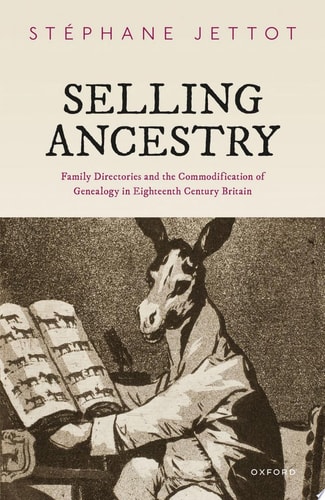
Selling Ancestry: Family Directories and the Commodification of Genealogy in Eighteenth Century Britain
0
0
As an Amazon Associate and affiliate partner, Menrva Books earns from qualifying purchases. Learn more
Author Description
Often cited but rarely studied in their own right, family directories allow a reconsideration of how ancestry and genealogy became an object of widespread commercialization across the eighteenth century. These directories replaced the expensive, locally-produced, early modern artefacts (tombs, windowpanes, illuminated pedigrees), and began to reach a wide audience of readers in the British Isles and the colonies. From the first Peerage in 1709 to the guidebooks of Debrett's and Burke's in the 1830s, Stéphane Jettot offers an insight into the cumulative process leading to the creation of these hybrid products -- a combination of court almanacs, county histories, and town directories. Employed by contemporaries as reference tools to navigate through a dynamic and changing society, they could be used as a means to probe contemporary attitudes towards social status and political events. Published by the most prominent London booksellers who shared their copyrights among themselves, they relied on the considerable involvement of thousands of families in the counties.In their correspondence with publishers, many new and old elites desired to insert their own narrative into a general history of Britain by dispatching documents, quotations, and anecdotes. Based on a unique source-base, this book provides a systematic review of these directories, their production, and sale, but also their potential role in shaping the character of social change. Jettot demonstrates the wider ramifications of genealogy and its structural ability to reinvent itself, associate amateurs and antiquarians alike, and thrive on the wavering lines between facts and fiction, offering an exciting and unique insight into the social history of eighteenth-century Britain.
Menrva's Summary
THE THESIS
This book investigates how the commercialization of family directories in eighteenth-century Britain transformed ancestry into a commodified product that reflected shifting social hierarchies. Dr. Stéphane Jettot, a historian specializing in early modern British society, utilizes a unique collection of publisher correspondence and archival records to analyze the production and consumption of these genealogical texts. He argues that these directories functioned as hybrid tools that allowed both the elite and the aspiring middle classes to negotiate their social status within a rapidly changing political landscape.
THE SCOPE MAP
What You Will Find
- An analysis of the evolution of genealogical publishing from the first Peerage in 1709 to the 1830s.
- A study of the collaborative relationship between London booksellers and families across the British Isles.
- Examination of how genealogical data was curated, verified, and sometimes fabricated to suit social ambitions.
Scope Limits
- The study focuses primarily on the British Isles and its colonies, excluding broader continental European genealogical trends.
- The analysis centers on the commercial and social aspects of these directories rather than providing a comprehensive biographical database of the families mentioned.
THE AUTHORITY PERSPECTIVE
Scholars recognize this work as a significant contribution to the history of the book and the social history of the eighteenth century. Readers frequently note the meticulous use of primary source correspondence to illustrate the intersection of commercial publishing and social identity.
Page Count:
416
Publication Date:
2023-01-01
Publisher:
Oxford University Press
ISBN-10:
019286596X
ISBN-13:
9780192865960
History
Eighteenth Century
Social History
Genealogy
British History
Great Britain
Publishing History
Community Tags
Similar Books