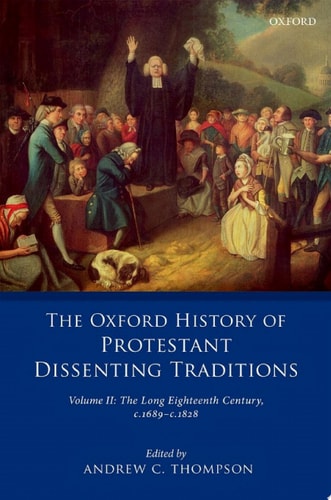
The Oxford History of Protestant Dissenting Traditions, Volume II: The Long Eighteenth Century c. 1689-c. 1828
0
0
As an Amazon Associate and affiliate partner, Menrva Books earns from qualifying purchases. Learn more
Author Description
The five-volume Oxford History of Dissenting Protestant Traditions series is governed by a motif of migration ('out-of-England'). It first traces organized church traditions that arose in England as Dissenters distanced themselves from a state church defined by diocesan episcopacy, the Book of Common Prayer, the Thirty-Nine Articles, and royal supremacy, but then follows those traditions as they spread beyond England -and also traces newer traditions that emerged downstream in other parts of the world from earlier forms of Dissent. Secondly, it does the same for the doctrines, church practices, stances toward state and society, attitudes toward Scripture, and characteristic patterns of organization that also originated in earlier English Dissent, but that have often defined a trajectory of influence independent ecclesiastical organizations. The Oxford History of Protestant Dissenting Traditions, Volume II charts the development of protestant Dissent between the passing of the Toleration Act (1689) and the repealing of the Test and Corporation Acts (1828). The long eighteenth century was a period in which Dissenters slowly moved from a position of being a persecuted minority to achieving a degree of acceptance and, eventually, full political rights. The first part of the volume considers the history of various dissenting traditions inside England. There are separate chapters devoted to Presbyterians, Congregationalists, Baptists and Quakers—the denominations that traced their history before this period—and also to Methodists, who emerged as one of the denominations of 'New Dissent' during the eighteenth century. The second part explores that ways in which these traditions developed outside England. It considers the complexities of being a Dissenter in Wales and Ireland, where the state church was Episcopalian, as well as in Scotland, where it was Presbyterian. It also looks at the development of Dissent across the Atlantic, where the relationship between church and s
Menrva's Summary
THE THESIS
This volume investigates the evolution of Protestant Dissenting traditions in the British Isles and beyond during the long eighteenth century, specifically examining the transition from legal persecution to political integration. Andrew C. Thompson, a scholar of early modern British history, utilizes a comparative framework to analyze how various denominations navigated their status relative to state-sanctioned churches. By synthesizing institutional history with broader social and political developments, the work argues that the trajectory of Dissent was defined by both internal theological shifts and external pressures from state authorities.
THE SCOPE MAP
What You Will Find
- Detailed analysis of the Toleration Act of 1689 and the repeal of the Test and Corporation Acts in 1828.
- Comparative studies of Presbyterians, Congregationalists, Baptists, Quakers, and the emergence of Methodism.
- Regional examinations of Dissenting experiences in England, Wales, Ireland, and Scotland.
- Analysis of the transatlantic expansion of Dissenting traditions.
Scope Limits
- The volume focuses primarily on the period between 1689 and 1828 and does not provide an exhaustive history of Dissent outside this specific timeframe.
- The text prioritizes institutional and political development over detailed biographical accounts of individual lay members.
THE AUTHORITY PERSPECTIVE
Scholars and historians identify this series as a definitive reference for understanding the institutional development of non-conformist traditions. Readers frequently note the academic density of the prose, which is tailored for researchers and students of ecclesiastical history.
Page Count:
486
Publication Date:
2018-01-01
Publisher:
OUP Oxford
ISBN-10:
0192518208
ISBN-13:
9780192518200
History
Religion
Protestantism
Christianity
Eighteenth Century
British History
Religious History
Community Tags
Similar Books



Reader Comments
Share Your Thoughts
No comments yet. Be the first to share your thoughts!