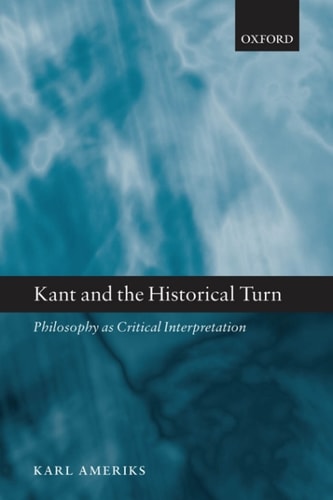
Kant and the Historical Turn: Philosophy As Critical Interpretation
0
0
As an Amazon Associate and affiliate partner, Menrva Books earns from qualifying purchases. Learn more
Author Description
Immanuel Kant's work changed the course of modern philosophy; in these essays Karl Ameriks examines how. He compares the philosophical system set out in Kant's Critiques with the work of the major philosophers before and after him (Descartes, Berkeley, Hume, Reid, Jacobi, Reinhold, the early German Romantics, Hegel, Feuerbach, and Marx). A systematic introduction argues that complexities in the interpretation of Kant's system led to a new emphasis on history, subjectivity, and aesthetics. This emphasis defined a distinctive interpretive style of philosophizing that has become especially influential and fruitful once again in our own time. The individual essays provide case studies in support of the thesis that late 18th-century reactions to Kant initiated an 'historical turn', after which historical and systematic considerations became joined in a way that fundamentally distinguishes philosophy from science and art, without falling back into mere historicism. In this way it is shown that philosophy's 'historical turn' is both similar to and unlike the turn to history undertaken by most other disciplines in this era. Part One argues that close attention to the historical context of Kant's philosophy is crucial to avoiding frequent misunderstandings that have arisen in comparing Kant with other major modern philosophers. Part Two contends that it was mainly the writing of Kant's first major interpreter that led to special philosophical emphasis on history in other major post-Kantian thinkers. Part Three argues that Hegel's system and its influence on post-Hegelians were determined largely by variations on Reinhold's historical turn. Part Four engages with major contemporary philosophers who have combined a study of particular themes in Kant and German Idealism with an appreciation for phenomena closely associated with the general notion of an historical turn in philosophy.
Menrva's Summary
THE THESIS
This work investigates how late 18th-century interpretations of Immanuel Kant’s philosophy initiated a fundamental 'historical turn' that distinguishes philosophical inquiry from scientific or artistic methodologies. Karl Ameriks, a scholar of German Idealism, utilizes a comparative framework to analyze the evolution of Kantian thought through the lens of his predecessors and successors, including Descartes, Hegel, and Marx. The text argues that the integration of historical context into systematic philosophy was not a descent into historicism, but a necessary development that shaped the trajectory of modern thought.
THE SCOPE MAP
What You Will Find
- Comparative analysis of Kant’s Critiques against thinkers like Hume, Jacobi, and Reinhold.
- Examination of the transition from Kantian systems to Hegelian and post-Hegelian philosophy.
- Case studies on the role of subjectivity and aesthetics in historical interpretation.
- Analysis of contemporary philosophical approaches to German Idealism.
Scope Limits
- The text does not provide a general biography of Immanuel Kant.
- It does not offer a comprehensive survey of all post-Kantian philosophy outside the specific focus on the 'historical turn'.
THE AUTHORITY PERSPECTIVE
Scholars frequently cite this collection as a rigorous contribution to the study of German Idealism and the reception history of Kantian thought. Readers often note the academic density of the prose, which is intended for advanced students and professional philosophers familiar with the primary texts of the era.
Page Count:
344
Publication Date:
2006-01-01
Publisher:
Clarendon Press
ISBN-10:
0191525545
ISBN-13:
9780191525544
Philosophy
Philosophy history
Intellectual History
History & Surveys
Kant
Community Tags
Similar Books