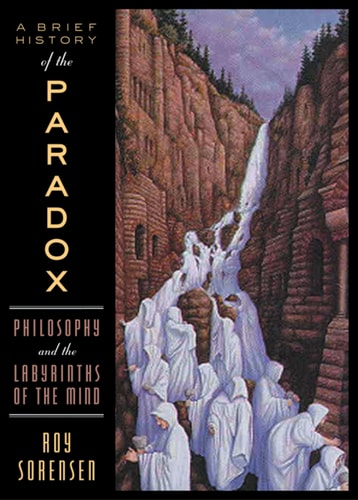
A Brief History of the Paradox: Philosophy and the Labyrinths of the Mind
0
0
As an Amazon Associate and affiliate partner, Menrva Books earns from qualifying purchases. Learn more
Author Description
Can God create a stone too heavy for him to lift? Can time have a beginning? Which came first, the chicken or the egg? Riddles, paradoxes, conundrums--for millennia the human mind has found such knotty logical problems both perplexing and irresistible. Now Roy Sorensen offers the first narrative history of paradoxes, a fascinating and eye-opening account that extends from the ancient Greeks, through the Middle Ages, the Enlightenment, and into the twentieth century. When Augustine asked what God was doing before He made the world, he was told: "Preparing hell for people who ask questions like that." A Brief History of the Paradox takes a close look at "questions like that" and the philosophers who have asked them, beginning with the folk riddles that inspired Anaximander to erect the first metaphysical system and ending with such thinkers as Lewis Carroll, Ludwig Wittgenstein, and W.V. Quine. Organized chronologically, the book is divided into twenty-four chapters, each of which pairs a philosopher with a major paradox, allowing for extended consideration and putting a human face on the strategies that have been taken toward these puzzles. Readers get to follow the minds of Zeno, Socrates, Aquinas, Ockham, Pascal, Kant, Hegel, and many other major philosophers deep inside the tangles of paradox, looking for, and sometimes finding, a way out. Filled with illuminating anecdotes and vividly written, A Brief History of the Paradox will appeal to anyone who finds trying to answer unanswerable questions a paradoxically pleasant endeavor.
Menrva's Summary
THE THESIS
How have paradoxes shaped the evolution of human thought and the development of metaphysical systems throughout history? Roy Sorensen, a professor of philosophy, utilizes his expertise to trace the intellectual lineage of logical conundrums from antiquity to the modern era. By examining the interplay between specific philosophers and the paradoxes that challenged their worldviews, the author constructs a chronological framework that illustrates how these logical knots have driven progress in human reasoning. The text serves as a bridge between abstract logical theory and the historical figures who grappled with the limits of language and reality.
THE SCOPE MAP
What You Will Find
- A chronological survey of twenty-four major paradoxes spanning from the ancient Greeks to twentieth-century analytic philosophy.
- Biographical sketches of key thinkers including Zeno, Socrates, Aquinas, Pascal, Kant, and Wittgenstein.
- Analysis of the transition from folk riddles to formal metaphysical systems.
Scope Limits
- The book does not provide a comprehensive technical manual for solving all logical paradoxes.
- It does not focus on contemporary computational or mathematical paradoxes outside the scope of traditional philosophical inquiry.
THE AUTHORITY PERSPECTIVE
Readers frequently note the accessible and engaging prose style that makes complex logical problems approachable for a general audience. Experts highlight this work as a useful introductory text for understanding the historical development of philosophical inquiry through the lens of its most persistent puzzles.
Page Count:
412
Publication Date:
2003-01-01
Publisher:
Oxford University Press
ISBN-10:
0190289317
ISBN-13:
9780190289317
Non-Fiction
Philosophy
History & Surveys
Mind & Body
Paradox
Logic
Philosophy history
Paradoxes
Intellectual History
Community Tags
Similar Books