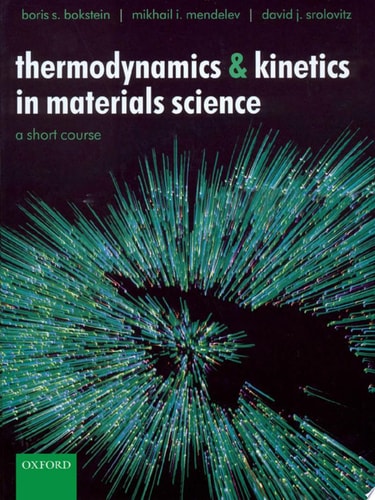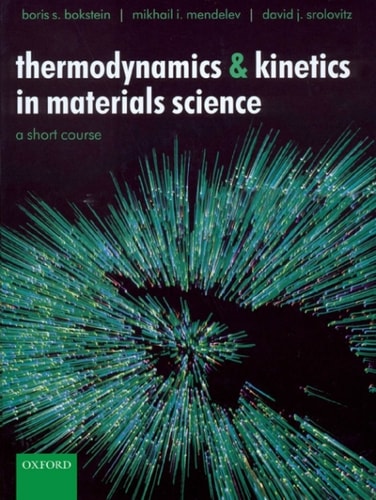
Thermodynamics and Kinetics in Materials Science: A Short Course
0
0
As an Amazon Associate and affiliate partner, Menrva Books earns from qualifying purchases. Learn more
Author Description
This text presents a concise and thorough introduction to the main concepts and practical applications of thermodynamics and kinetics in materials science. It is designed with two types of uses in mind: firstly for a one or two semester university course for mid- to upper-level undergraduate or first year graduate students in a materials-science-oriented discipline and secondly for individuals who want to study the material on their own. The following major topics are discussed: basic laws of classical and irreversible thermodynamics, phase equilibria, theory of solutions, chemical reaction thermodynamics and kinetics, surface phenomena, stressed systems, diffusion and statistical thermodynamics. A large number of example problems with detailed solutions are included as well as accompanying computer-based self-tests, consisting of over 400 questions and 2000 answers with hints for students. Computer-based laboratories are provided, in which a laboratory problem is posed and the experiment described. The student can "perform" the experiments and change the laboratory conditions to obtain the data required for meeting the laboratory objective. Each "laboratory" is augmented with background material to aid analysis of the experimental results.
Menrva's Summary
THE THESIS
This text investigates the fundamental principles of thermodynamics and kinetics as they apply to the behavior and processing of materials. The authors, Boris S. Bokstein, David J. Srolovitz, and Mikhail I. Mendelev, leverage their academic expertise to synthesize classical and irreversible thermodynamic laws into a framework suitable for materials science applications. The book utilizes a combination of theoretical derivation and practical problem-solving to bridge the gap between abstract physical laws and real-world material behavior.
THE SCOPE MAP
What You Will Find
- Coverage of phase equilibria, theory of solutions, and surface phenomena
- Analysis of chemical reaction kinetics and diffusion processes
- Statistical thermodynamics and the behavior of stressed systems
- Over 400 self-test questions and 2000 answers with hints
- Interactive computer-based laboratory simulations
Scope Limits
- Advanced quantum mechanical derivations of thermodynamic properties
- Comprehensive coverage of non-metallic or biological material systems
THE AUTHORITY PERSPECTIVE
Experts and educators recognize this text as a highly structured resource for students transitioning from introductory physics to specialized materials science coursework. Readers frequently note that the inclusion of computer-based laboratories and extensive problem sets makes the material particularly accessible for self-directed study.
Page Count:
344
Publication Date:
2005-01-01
Publisher:
OUP Oxford
ISBN-10:
0191523682
ISBN-13:
9780191523687
Engineering
Industrial Technology
Materials Science
Chemistry
Physics
Trades & Technology
Thermodynamics
Kinetics