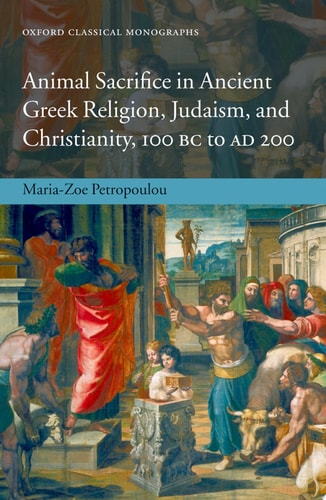
Animal Sacrifice in Ancient Greek Religion, Judaism, and Christianity, 100 BC to AD 200
0
0
As an Amazon Associate and affiliate partner, Menrva Books earns from qualifying purchases. Learn more
Author Description
A study of animal sacrifice within Greek paganism, Judaism, and Christianity during the period of their interaction between about 100 BC and AD 200. After a vivid account of the realities of sacrifice in the Greek East and in the Jerusalem Temple (up to AD 70), Maria-Zoe Petropoulou explores the attitudes of early Christians towards this practice. Contrary to other studies in this area, she demonstrates that the process by which Christianity finally separated its own cultic code from the strong tradition of animal sacrifice was a slow and difficult one. Petropoulou places special emphasis on the fact that Christians gave completely new meanings to the term `sacrifice'. She also explores the question why, if animal sacrifice was of prime importance in the eastern Mediterranean at this time, Christians should ultimately have rejected it.
Menrva's Summary
THE THESIS
This study investigates the complex transition and eventual rejection of animal sacrifice within the religious frameworks of Ancient Greek paganism, Judaism, and early Christianity between 100 BC and AD 200. Maria-Zoe Petropoulou, a scholar of classical antiquity, utilizes historical records and theological texts to examine how these three traditions interacted and influenced one another. Her central argument posits that the abandonment of animal sacrifice by early Christians was not an immediate break but a protracted, multifaceted process involving the redefinition of sacrificial terminology.
THE SCOPE MAP
What You Will Find
- Comparative analysis of cultic practices in the Greek East and the Jerusalem Temple.
- Examination of the theological shift in the meaning of 'sacrifice' within early Christian thought.
- Historical documentation of religious interactions in the Mediterranean basin.
Scope Limits
- The study focuses primarily on the period between 100 BC and AD 200.
- It does not provide an exhaustive history of animal sacrifice beyond the specified geographic and temporal constraints.
THE AUTHORITY PERSPECTIVE
Scholars frequently cite this monograph as a rigorous contribution to the study of religious evolution in the ancient Mediterranean. Experts note that the text provides a nuanced perspective on the slow divergence of Christian cultic identity from established pagan and Jewish traditions.
Page Count:
352
Publication Date:
2008-01-01
Publisher:
OUP Oxford
ISBN-10:
0191527351
ISBN-13:
9780191527357
History
Religion
Ancient History
Sacrifice
Greece
Cults greece
Liturgies Early Christian
Christianity
Religious Aspects
Judaism