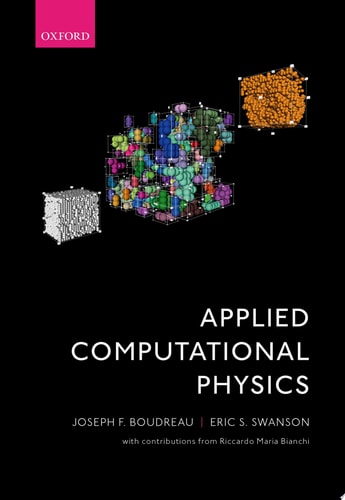
Applied Computational Physics
0
0
As an Amazon Associate and affiliate partner, Menrva Books earns from qualifying purchases. Learn more
Author Description
Applied Computational Physics is a graduate-level text stressing three essential elements: advanced programming techniques, numerical analysis, and physics. The goal of the text is to provide students with essential computational skills that they will need in their careers, and to increase the confidence with which they write computer programs designed for their problem domain. The physics problems give them an opportunity to reinforce their programming skills, while the acquired programming skills augment their ability to solve physics problems. The C++ language is used throughout the text. Physics problems include Hamiltonian systems, chaotic systems, percolation, critical phenomena, few-body and multi-body quantum systems, quantum field theory, simulation of radiation transport, and data modeling. The book, the fruit of a collaboration between a theoretical physicist and an experimental physicist, covers a broad range of topics from both viewpoints. Examples, program libraries, and additional documentation can be found at the companion website. Hundreds of original problems reinforce programming skills and increase the ability to solve real-life physics problems at and beyond the graduate level.
Menrva's Summary
THE THESIS
This text investigates the intersection of advanced programming, numerical analysis, and physical modeling to equip graduate students with the computational proficiency required for professional research. Authors Eric S. Swanson and Joseph F. Boudreau leverage their combined expertise in theoretical and experimental physics to present a framework where programming techniques and physical problem-solving are mutually reinforcing. The book utilizes C++ as the primary medium for implementing numerical solutions to complex physical phenomena.
THE SCOPE MAP
What You Will Find
- Numerical analysis techniques applied to Hamiltonian and chaotic systems
- Implementation of C++ for quantum field theory and multi-body quantum systems
- Simulation methodologies for radiation transport and data modeling
- Pedagogical approach integrating theoretical and experimental viewpoints
Scope Limits
- The text assumes a graduate-level background in physics and does not provide introductory programming instruction
- Coverage is restricted to the specific physical systems listed and does not encompass all areas of computational science
THE AUTHORITY PERSPECTIVE
Experts highlight this text as a rigorous resource for graduate students seeking to bridge the gap between abstract physics and practical software implementation. Readers frequently note the technical density of the prose and the utility of the provided problem sets in developing professional-grade computational skills.
Page Count:
944
Publication Date:
2017-01-01
Publisher:
OUP Oxford
ISBN-10:
0191018988
ISBN-13:
9780191018985
Physics
Computational Physics
Earth Sciences
Computer Science
textbook
Mathematical Physics
Numerical analysis
Community Tags
Similar Books