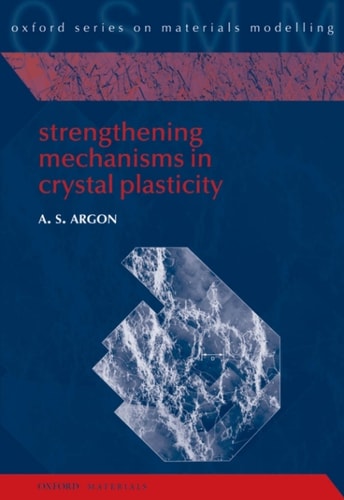
Strengthening Mechanisms in Crystal Plasticity
0
0
As an Amazon Associate and affiliate partner, Menrva Books earns from qualifying purchases. Learn more
Author Description
The strengthening of metals by a variety of means has been of interest over much of history. However, the elucidation of the actual mechanisms involved in the processes of alloying and work hardening, and the related processes of metals as a scientific pursuit, has become possible only through the parallel developments in dislocation theory and in definitive experimental tools of electron microscopy and X-ray diffraction. The important developments over the past several decades in the mechanistic understanding of the often complex processes of interaction of dislocations with each other, with solute atoms and with precipitates during plastic flow have largely remained scattered in the professional literature. This has made it difficult for students and professionals to have ready access to this subject as a whole. While there are some excellent reviews of certain aspects of the subject, there is presently no single comprehensive coverage available of the central mechanisms and their modelling. The present book on Strengthening Mechanisms in Crystal Plasticity provides such a coverage in a generally transparent and readily understandable form. It is intended as an advanced text for graduate students in materials science and mechanical engineering. The central processes of strengthening that are presented are modeled by dislocation mechanics in detail and the results are compared extensively with the best available experimental information. The form of the coverage is intended to inspire students or professional practitioners in the field to develop their own models of similar or related phenomena and, finally, engage in more advanced computational simulations, guided by the book.
Menrva's Summary
THE THESIS
This book investigates the fundamental mechanisms of metal strengthening by synthesizing dislocation theory with experimental data to provide a unified modeling framework. Author Ali Argon, a recognized expert in the field, addresses the historical fragmentation of research regarding alloying and work hardening. By consolidating complex interactions between dislocations, solute atoms, and precipitates, the text offers a structured approach for graduate-level study and professional application in materials science.
THE SCOPE MAP
What You Will Find
- Detailed modeling of dislocation mechanics during plastic flow
- Comparative analysis of theoretical models against experimental electron microscopy and X-ray diffraction data
- Methodologies for developing independent computational simulations of strengthening phenomena
Scope Limits
- Does not cover non-crystalline materials or amorphous solids
- Excludes basic introductory materials science concepts, assuming prior graduate-level knowledge
THE AUTHORITY PERSPECTIVE
Experts recognize this text as a vital resource for bridging the gap between theoretical dislocation mechanics and practical engineering applications. Readers frequently note the high level of technical density, making it a standard reference for advanced students and researchers in the field of crystal plasticity.
Page Count:
404
Publication Date:
2007-01-01
Publisher:
OUP Oxford
ISBN-10:
0191523364
ISBN-13:
9780191523366
Mechanical engineering
Dislocation Theory
Physics
Crystal Plasticity
Earth Sciences
Metallurgy
Community Tags
Other Editions(3)
Similar Books

Reader Comments
Share Your Thoughts
No comments yet. Be the first to share your thoughts!