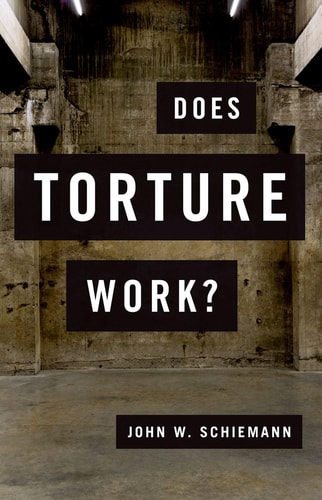
Does Torture Work?
0
0
As an Amazon Associate and affiliate partner, Menrva Books earns from qualifying purchases. Learn more
Author Description
When the Senate released its so-called "Torture Report" in December 2014 the world would learn that, for years, the CIA had used unimaginably brutal methods to interrogate its prisoners - often without yielding any useful or truthful information. The agency had long and adamantly defended its use of torture, staunchly arguing that it was not only just but necessary for the country's safety. And even amid the revelations of the report, questions abound about whether torture can be considered a justifiable tool of national security.Is interrogational torture an effective method of extracting information? How good does the information extracted need to be for the torture to be considered successful? How often or how vigorously must torture be used to achieve valuable information? It may be the case that interrogational torture can never be justified under any circumstances, but, according to John Schiemann, if it is to be justified at all, it must be effective. According to more than one national poll, most Americans do believe that torture can work, and that it can be justified under certain circumstances. But if the information that torturers extract is bad, then the method amounts to nothing more than pure sadism. So, how can we solve the dilemma over whether to torture or not to torture?In this book, John Schiemann takes a truly unique approach to the question of torture: game theory. Thinking of torture as a "game" played between an interrogator and a detainee, the book walks the reader through the logic of interrogational torture, comparing the outcomes to the claims made by torture proponents. The book draws on a wide variety of sources ranging from records of the Inquisition to secret CIA memos to trace this logic, illustrating each outcome of the model with a narrative from the real world of interrogational torture. Does Torture Work? is an absorbing and provocative take on one of the most discussed human rights and security dilemmas of our time.
Menrva's Summary
THE THESIS
Does interrogational torture function as an effective mechanism for extracting reliable information, or does it fail to meet the standards of utility required to justify its use? John W. Schiemann, a political scientist specializing in game theory, applies formal modeling to the interaction between interrogator and detainee. By analyzing the strategic incentives and information asymmetries inherent in these encounters, Schiemann evaluates whether the claims made by torture proponents hold up under logical scrutiny.
THE SCOPE MAP
What You Will Find
- A game-theoretic model of the interrogator-detainee interaction
- Comparative analysis of historical and modern interrogation records
- Case studies ranging from the Inquisition to CIA detention programs
Scope Limits
- The book does not provide a moral or legal argument against torture, focusing strictly on the question of efficacy
- It does not cover the psychological long-term effects on the interrogators themselves
THE AUTHORITY PERSPECTIVE
Experts and reviewers frequently note that the book provides a rigorous, analytical framework that strips away political rhetoric to focus on the mechanics of information extraction. Readers often highlight the author's ability to make complex game theory concepts accessible while maintaining a clinical, objective tone throughout the investigation.
Page Count:
336
Publication Date:
2015-11-02
Publisher:
Oxford University Press
ISBN-10:
0190262362
ISBN-13:
9780190262365
Military History
International relations
Terrorism
International Security
Ethics
Human rights
Game theory
Torture
Community Tags
Other Editions(4)
Similar Books






Reader Comments
Share Your Thoughts
No comments yet. Be the first to share your thoughts!