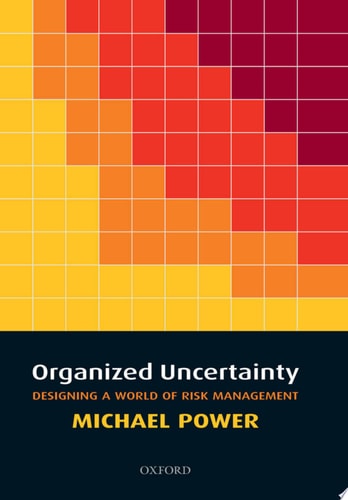
Organized Uncertainty: Designing a World of Risk Management
0
0
As an Amazon Associate and affiliate partner, Menrva Books earns from qualifying purchases. Learn more
Author Description
Since the mid-1990s risk management has undergone a dramatic expansion in its reach and significance, being transformed from an aspect of management control to become a benchmark of good governance for banks, hospitals, schools, charities and many other organizations. Numerous standards for risk management practice have been produced by a variety of transnational organizations. While these many designs and blueprints are accompanied by ideals of enterprise, value production, and good governance, it is argued that the rise of risk management has also coincided with an intensification of auditing and control processes. The legalization and bureacratization of organizational life has increased because risk management has created new demands for proof and evidence of action. In turn, these demands have generated new risks to reputation. In short, this important book traces the rise of the managerial concept of risk and the different logics and values which underpin it, showing that it has much less to do with real dangers and opportunities than might be thought, and more to do with organizational accountability and legitimacy.
Menrva's Summary
THE THESIS
This book investigates the transformation of risk management from a technical management tool into a pervasive benchmark for organizational governance and legitimacy. Michael Power, a professor of accounting and a specialist in the sociology of risk, utilizes institutional analysis to argue that the proliferation of risk management standards is less about mitigating actual hazards and more about satisfying the bureaucratic requirements of accountability. He demonstrates how the formalization of risk processes often creates new reputational risks while intensifying the audit culture within modern institutions.
THE SCOPE MAP
What You Will Find
- Analysis of the expansion of risk management practices since the mid-1990s.
- Examination of transnational standards and blueprints for organizational control.
- Discussion on the relationship between risk management, audit processes, and organizational bureaucracy.
Scope Limits
- The text does not provide a technical manual or a how-to guide for implementing specific risk assessment software or financial models.
THE AUTHORITY PERSPECTIVE
Experts recognize this work as a foundational text in the sociology of organizations and management studies. Readers frequently note the academic density of the prose, which is best suited for scholars and practitioners interested in the critical theory behind modern governance structures.
Page Count:
275
Publication Date:
2007-01-01
Publisher:
Oxford University Press
ISBN-10:
0191531146
ISBN-13:
9780191531149
Business
Insurance
Governance
Management
Sociology
Organizational Theory
Uncertainty
Community Tags
Similar Books