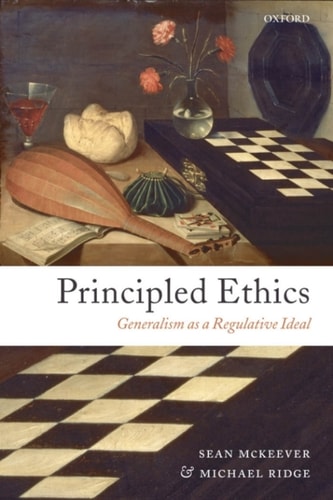
Principled Ethics: Generalism As a Regulative Ideal
0
0
As an Amazon Associate and affiliate partner, Menrva Books earns from qualifying purchases. Learn more
Author Description
Moral philosophy has long been dominated by the aim of understanding morality and the virtues in terms of principles. However, the underlying assumption that this is the best approach has received almost no defence, and has been attacked by particularists, who argue that the traditional link between morality and principles is little more than an unwarranted prejudice. In Principled Ethics, Michael Ridge and Sean McKeever meet the particularist challenge head on, and defend a distinctive view they call 'generalism as a regulative ideal'. After cataloguing the wide array of views that have gone under the heading 'particularism' they explain why the main particularist arguments fail to establish their conclusions. The authors' generalism incorporates what is most insightful in particularism (e.g. the possibility that reasons are context-sensitive - 'holism' about reasons) while rejecting every major particularist doctrine. At the same time, they avoid the excesses of hyper-generalist views according to which moral thought is constituted by allegiance to a particular principle or set of principles. Instead, they argue that insofar as moral knowledge and practical wisdom are possible, we both can and should codify all of morality in a manageable set of principles even if we are not yet in possession of those principles. Moral theory is in this sense a work in progress. Nor is the availability of a principled codification of morality an idle curiosity. Ridge and McKeever also argue that principles have an important role to play in guiding the virtuous agent.
Menrva's Summary
THE THESIS
This work investigates whether moral philosophy can be effectively structured through principles in the face of challenges from moral particularism. The authors, Michael Ridge and Sean McKeever, utilize a rigorous analytical framework to evaluate the validity of particularist critiques against traditional moral codification. They propose a middle-ground position termed 'generalism as a regulative ideal,' which posits that while moral knowledge may be context-sensitive, the pursuit of a principled moral system remains a necessary and achievable objective for practical wisdom.
THE SCOPE MAP
What You Will Find
- A comprehensive taxonomy of various particularist philosophical positions.
- An analysis of the 'holism of reasons' and its compatibility with generalist frameworks.
- A defense of the role of principles in guiding the actions of a virtuous agent.
Scope Limits
- The text does not provide a definitive, completed set of moral principles.
- The analysis focuses primarily on metaethical theory rather than applied ethics or specific policy recommendations.
THE AUTHORITY PERSPECTIVE
Scholars in the field of metaethics recognize this text as a significant contribution to the debate between particularism and generalism. Readers frequently note the academic density of the prose, which is tailored for advanced students and professional philosophers.
Page Count:
256
Publication Date:
2006-01-01
Publisher:
Oxford University Press
ISBN-10:
019153742X
ISBN-13:
9780191537424
Philosophy
Academic
Metaethics
Ethics
Moral Philosophy
Community Tags
Similar Books