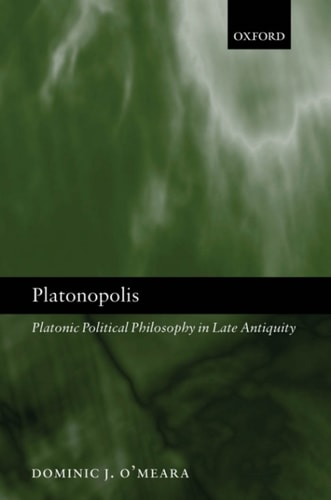
Platonopolis: Platonic Political Philosophy in Late Antiquity
0
0
As an Amazon Associate and affiliate partner, Menrva Books earns from qualifying purchases. Learn more
Author Description
Conventional wisdom suggests that the Platonist philosophers of Late Antiquity, from Plotinus (third century) to the sixth-century schools in Athens and Alexandria, neglected the political dimension of their Platonic heritage in their concentration on an otherworldly life. Dominic O'Meara presents a revelatory reappraisal of these thinkers, arguing that their otherworldliness involved rather than excluded political ideas, and he proposes for the first time a reconstruction of their political philosophy, their conception of the function, structure, and contents of political science, and its relation to political virtue and to the divinization of soul and state. Among the topics discussed by O'Meara are: philosopher-kings and queens; political goals and levels of reform: law, constitutions, justice, and penology; the political function of religion; and the limits of political science and action. He also explores various reactions to these political ideas in the works of Christian and Islamic writers, in particular Eusebius, Augustine, Pseudo-Dionysius, and al-Farabi. Filling a major gap in our understanding, Platonopolis will be of substantial interest to scholars and students of ancient philosophy, classicists, and historians of political thought.
Menrva's Summary
THE THESIS
This work investigates the neglected political dimensions of Late Antique Platonism, challenging the assumption that these philosophers focused exclusively on otherworldly concerns. Dominic J. O'Meara, a scholar of ancient philosophy, utilizes a rigorous analysis of primary texts from the third to the sixth centuries to reconstruct the political theories of the Neoplatonic schools. He argues that the pursuit of divinization and the soul's ascent were intrinsically linked to the organization of the state and the practice of political virtue.
THE SCOPE MAP
What You Will Find
- Reconstruction of Neoplatonic political science, including concepts of law, justice, and penology.
- Analysis of the role of philosopher-rulers and the political function of religion.
- Comparative study of political thought in the works of Eusebius, Augustine, Pseudo-Dionysius, and al-Farabi.
Scope Limits
- The text focuses primarily on the Neoplatonic tradition and does not provide an exhaustive history of all political thought in Late Antiquity.
- It does not offer a modern practical application of these ancient political theories.
THE AUTHORITY PERSPECTIVE
Scholars recognize this text as a significant contribution to the field, effectively correcting the historical misconception that Neoplatonism was inherently apolitical. Readers frequently note the academic density of the prose, which serves as a foundational resource for those studying the intersection of classical philosophy and political theory.
Page Count:
264
Publication Date:
2003-01-01
Publisher:
Clarendon Press
ISBN-10:
0191531529
ISBN-13:
9780191531521
History
Philosophy
Platonists
Late Antiquity
History & Surveys
Community Tags
Similar Books