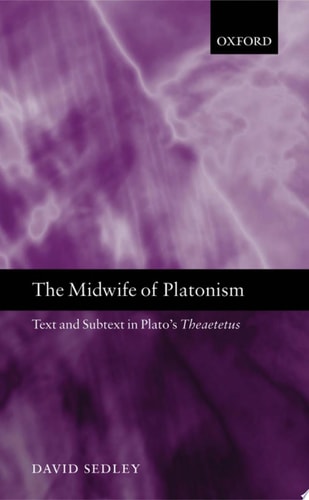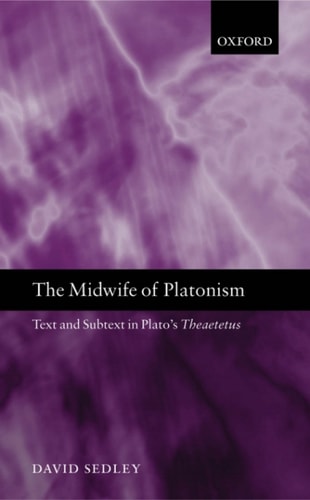
The Midwife of Platonism: Text and Subtext in Plato's Theaetetus
0
0
As an Amazon Associate and affiliate partner, Menrva Books earns from qualifying purchases. Learn more
Author Description
Plato's Theaetetus is an acknowledged masterpiece, and among the most influential texts in the history of epistemology. Since antiquity it has been debated whether this dialogue was written by Plato to support his familiar metaphysical doctrines, or represents a self-distancing from these. David Sedley's book offers a via media, founded on a radical separation of the author, Plato, from his main speaker, Socrates. The dialogue, it is argued, is addressed to readers familiar with Plato's mature doctrines, and sets out to show how these doctrines, far from being an abandonment of his Socratic heritage, are its natural outcome. The Socrates portrayed here is the same Socrates as already portrayed in Plato's early dialogues. While not a Platonist, he is exhibited - to put it in terms of an image made famous by this dialogue - as having been Platonism's midwife. In a comprehensive rereading of the text, Sedley tracks the ways in which Socrates is shown unwittingly preparing the ground for Plato's mature doctrines, and reinterprets the dialogue's individual arguments from this perspective. The book is addressed to all readers interested in Plato, and does not require knowledge of Greek.
Menrva's Summary
THE THESIS
This book investigates whether Plato's Theaetetus serves as a defense of his mature metaphysical doctrines or as a departure from them. David Sedley, a prominent scholar of ancient philosophy, proposes a middle path by distinguishing between the author, Plato, and the dialogue's primary speaker, Socrates. By analyzing the text as a work intended for readers already familiar with Plato's later philosophy, Sedley argues that the dialogue demonstrates how Plato's mature thought functions as the logical evolution of his Socratic roots.
THE SCOPE MAP
What You Will Find
- A comprehensive re-examination of the arguments within the Theaetetus.
- A framework for interpreting the relationship between Socratic inquiry and Platonic metaphysics.
- An analysis of the midwife metaphor as a structural device for the dialogue.
Scope Limits
- The book does not require the reader to possess knowledge of the Ancient Greek language.
- It focuses specifically on the Theaetetus rather than providing a general survey of all Platonic dialogues.
THE AUTHORITY PERSPECTIVE
Scholars and students of philosophy frequently cite this work as a significant contribution to the study of Platonic epistemology. Readers often note the academic density of the prose, which provides a rigorous and detailed reinterpretation of the dialogue's central arguments.
Page Count:
224
Publication Date:
2006-01-01
Publisher:
Clarendon Press
ISBN-10:
0191532983
ISBN-13:
9780191532986
Philosophy
Plato
History & Surveys
Platonists
Epistemology