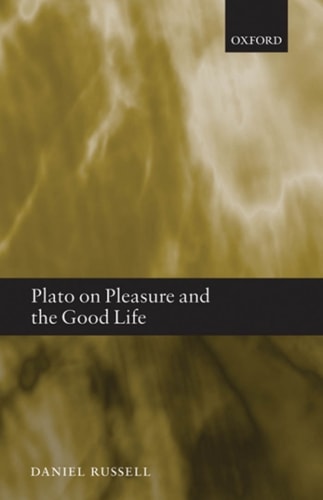
Plato on Pleasure and the Good Life
0
0
As an Amazon Associate and affiliate partner, Menrva Books earns from qualifying purchases. Learn more
Author Description
Daniel Russell examines Plato's subtle and insightful analysis of pleasure and explores its intimate connections with his discussions of value and human psychology. Russell offers a fresh perspective on how good things bear on happiness in Plato's ethics, and shows that, for Plato, pleasure cannot determine happiness because pleasure lacks a direction of its own. Plato presents wisdom as a skill of living that determines happiness by directing one's life as a whole, bringing about goodness in all areas of one's life, as a skill brings about order in its materials. The 'materials' of the skill of living are, in the first instance, not things like money or health, but one's attitudes, emotions, and desires where things like money and health are concerned. Plato recognizes that these 'materials' of the psyche are inchoate, ethically speaking, and in need of direction from wisdom. Among them is pleasure, which Plato treats not as a sensation but as an attitude with which one ascribes value to its object. However, Plato also views pleasure, once shaped and directed by wisdom, as a crucial part of a virtuous character as a whole. Consequently, Plato rejects all forms of hedonism, which allows happiness to be determined by a part of the psyche that does not direct one's life but is among the materials to be directed. At the same time, Plato is also able to hold both that virtue is sufficient for happiness, and that pleasure is necessary for happiness, not as an addition to one's virtue, but as a constituent of one's whole virtuous character itself. Plato therefore offers an illuminating role for pleasure in ethics and psychology, one to which we may be unaccustomed: pleasure emerges not as a sensation or even a mode of activity, but as an attitude - one of the ways in which we construe our world - and as such, a central part of every character.
Menrva's Summary
THE THESIS
This work investigates the core question of how pleasure functions within Plato's ethical framework and its relationship to the attainment of a good life. Daniel Russell, a scholar of ancient philosophy, utilizes a close reading of Platonic dialogues to argue that Plato views pleasure not as a mere sensation, but as an attitude shaped by wisdom. By analyzing the psyche as a system requiring direction, Russell demonstrates how Plato integrates pleasure into a virtuous character while rejecting hedonism.
THE SCOPE MAP
What You Will Find
- An analysis of the relationship between wisdom, virtue, and happiness in Platonic ethics.
- A reinterpretation of pleasure as an attitude of value-ascription rather than a sensory experience.
- A systematic breakdown of how the 'skill of living' organizes human desires and emotions.
Scope Limits
- The text does not provide a comprehensive history of hedonism outside of the Platonic context.
- The analysis focuses primarily on ethical and psychological dimensions rather than political or metaphysical implications.
THE AUTHORITY PERSPECTIVE
Scholars and students of ancient philosophy frequently cite this text for its rigorous and nuanced approach to Platonic psychology. Experts highlight the work as a significant contribution to understanding the role of pleasure in classical ethics, noting the clarity of the author's philosophical arguments.
Page Count:
340
Publication Date:
2005-01-01
Publisher:
Clarendon Press
ISBN-10:
019153613X
ISBN-13:
9780191536137
Psychology
Philosophy
Psychology
History & Surveys
Ethics
Plato
Community Tags
Other Editions(2)
Similar Books








Reader Comments
Share Your Thoughts
No comments yet. Be the first to share your thoughts!