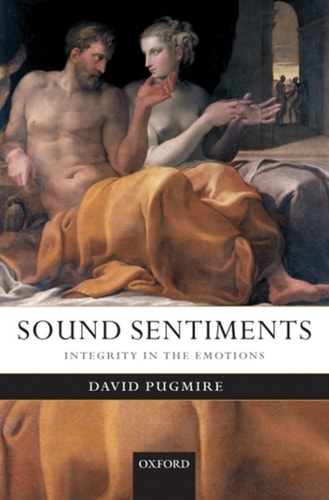
Sound Sentiments: Integrity in the Emotions
0
0
As an Amazon Associate and affiliate partner, Menrva Books earns from qualifying purchases. Learn more
Author Description
Sound Sentiments seeks to open a new path in the philosophy of emotion. The focus of most recent work on the philosophy of emotion has been on the nature of emotion, with some attention also to the relation of emotion to ethics. This book explores the idea that emotions admit of valuation, of degrees of adequacy. We cannot just decide what to think, or to desire, or to feel, as we can decide to act, and these attitudes are integral to emotions. Nonetheless, emotions can have normative characteristics that resemble virtues. Philosophers are familiar with the notion that emotions are valuational. But how well they serve that function determines the value they themselves have. The book opens with an account of the theory of emotion, reflecting recent work on that, and considers the way in which emotions are valuational (with reference to the contributions of writers such as de Sousa, Gibbard, and McDowell). The worth of an emotional experience depends on the quality of the valuation it itself achieves. Most of the book is then devoted to a set of interconnected themes. Some of these concern properties that emotions can have which can variously enhance or detract from them: profundity, social leverage, narcissism, and sentimentality. Others are attitudes with characteristic emotional loadings, and sometimes motivations, that raise similar questions: cynicism, ambivalence, and sophistication. David Pugmire's general approach is indirect and negative: to analyse emotional foibles, which tend to elude us as we succumb to them, and thereby to point to what soundness in emotion would be. He also elicits connections amongst these aspects of the emotional life. The most pervasive is the dimension of profundity, which opens the discussion: each of the subsequent problems amounts to a way in which emotion can be shallow and slight and so amount to less than it seems; and accordingly, each identifies a form of integrity in the emotions.
Menrva's Summary
THE THESIS
This book investigates the normative dimensions of human emotion, specifically questioning how emotions can be evaluated for their integrity and adequacy. David Pugmire, a philosopher, utilizes a framework that treats emotions as valuational states rather than mere passive reactions. By analyzing emotional foibles such as narcissism and sentimentality, the author argues that the quality of an emotion depends on its depth and its capacity to accurately reflect the world, ultimately defining what constitutes a sound emotional life.
THE SCOPE MAP
What You Will Find
- A theoretical account of emotion as a valuational process
- Analysis of specific emotional states including cynicism, ambivalence, and sophistication
- Examination of the concept of profundity as a measure of emotional integrity
- Philosophical discourse referencing de Sousa, Gibbard, and McDowell
Scope Limits
- The text does not provide a psychological or clinical guide for emotional regulation
- It does not focus on the biological or neurological mechanisms of emotional response
THE AUTHORITY PERSPECTIVE
Experts recognize this work as a significant contribution to the philosophy of emotion, particularly for its focus on the normative aspects of feeling. Readers frequently note the academic density of the prose, which is intended for those with a background in moral philosophy or meta-ethics.
Page Count:
222
Publication Date:
2005-01-01
Publisher:
Clarendon Press
ISBN-10:
0191534951
ISBN-13:
9780191534959
Philosophy
Non-Fiction
Ethics
Mind & Body
Emotions
Community Tags
Similar Books