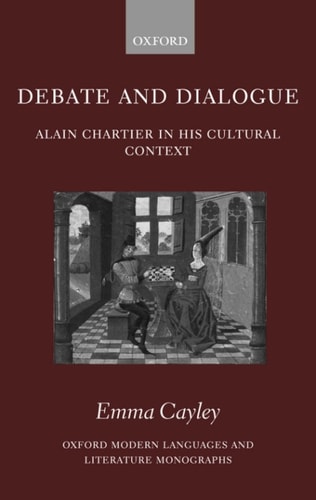
Debate and Dialogue: Alain Chartier in His Cultural Context
0
0
As an Amazon Associate and affiliate partner, Menrva Books earns from qualifying purchases. Learn more
Author Description
In early humanist France two debating traditions converge: one literary and vernacular, one intellectual and conducted mainly via Latin epistles. Debate and Dialogue demonstrates how the two fuse in the vernacular verse debates of Alain Chartier, secretary and notary at the court of Charles VI, and later, Charles VII. In spite of considerable contemporary praise for Chartier, his work has remained largely neglected by modern critics. This study shows how Chartier participates in a movement that invests a vernacular poetic with moral and political significance, inspiring such social engagements as the fifteenth-century poetic exchange known as the Querelle de la Belle Dame sans mercy. Emma Cayley sets Chartier in the context of a late-medieval debating climate through the use of a new model of participatory poetics which she terms the collaborative debating community. This is a dynamic and generative social grouping based on Brian Stock's model of the textual community, as well as Pierre Bourdieu's sociological categories of field, habitus, and capital. This dialectical model takes account of the socio-cultural context of literary production, and suggests the fundamentally competitive yet collaborative nature of late-medieval poetry. Cayley draws an analogy here between literary debates and game-playing, engaging with the game theory of Johan Huizinga and Roger Caillois, and discusses the manuscript context of such literary debates as the materialization of this poetic game. The collaborative debating community postulated affords unique insights into the dynamics of late-medieval compositional and reading practices.
Menrva's Summary
THE THESIS
This study investigates how the vernacular verse debates of Alain Chartier bridge the gap between literary traditions and intellectual Latin epistolary culture in early humanist France. Emma Cayley, a scholar of medieval French literature, utilizes a multidisciplinary framework to analyze Chartier's role as a court secretary and poet. By applying sociological models and game theory, she argues that Chartier's work reflects a sophisticated, collaborative debating community that shaped late-medieval social and political discourse.
THE SCOPE MAP
What You Will Find
- Analysis of late-medieval French poetic exchanges, specifically the Querelle de la Belle Dame sans mercy.
- Application of Brian Stock’s textual community model and Pierre Bourdieu’s sociological categories.
- Integration of game theory concepts from Johan Huizinga and Roger Caillois to explain literary competition.
- Examination of manuscript culture as a physical manifestation of poetic dialogue.
Scope Limits
- The study focuses primarily on the specific context of fifteenth-century French courtly literature and may not address broader European literary developments of the same period.
THE AUTHORITY PERSPECTIVE
Scholars recognize this work as a significant contribution to the study of late-medieval French literary practices and the specific role of Alain Chartier. Readers frequently note the academic density of the prose, which requires a foundational understanding of both medieval history and sociological theory.
Page Count:
272
Publication Date:
2006-01-01
Publisher:
Clarendon Press
ISBN-10:
0191537330
ISBN-13:
9780191537332
Poetry
History
English & College Success
English
English literature
French literature
Literary Criticism
Community Tags
Similar Books